Get the latest price? We will reply as soon as possible (within 12 hours)

Product News

  • Which Sucker Rod Pump Should Be Used for Shale Oil Wells in the United States?
    06-12/2025
    We all know that although the artificial lift sucker rod pump is only a part of the downhole equipment, its selection has a particularly large impact on the life and production capacity of the well. Especially after the shale oil wells in the United States enter the middle and late stages, the well conditions are becoming more and more complicated, and the production is gradually declining. The quality and performance of the artificial lift sucker rod pump are directly related to whether the production can be stabilized and the shutdown and maintenance can be reduced.
  • Common Knowledge of Underground Operations That You Must Know
    06-09/2025
    1. Oil well (pump inspection) operation: The methods of extracting oil from the formation can be divided into two categories: one is to use the energy of the formation itself to lift crude oil, which is called self-flowing oil production; the other is that due to the lack of energy in the formation itself, it is necessary to artificially use mechanical equipment to supplement the energy of the liquid in the well in order to lift the crude oil to the ground, which is called artificial lifting oil production or mechanical oil production. At present, the main artificial lifting methods in oil fields are gas lift, insert rod pump oil production and rodless pump oil production. insert rod pump oil production includes pumping unit insert rod pump and ground driven screw pump (generally not used). Rodless pump oil production includes electric submersible pumps, hydraulic piston pumps, jet pumps, etc. Regardless of the lifting oil production method used, due to adjustments to the oil field development plan, equipment failures, etc., pump inspection (replacement) operations are required. 2.Check (replace) the insert rod pump: The insert rod pump is a method of producing oil by transferring the reciprocating motion of the pumping unit suspension point to the pumping pump through the sucker rod, and the insert rod pump piston moves up and down to take out the liquid in the well. insert rod pump is currently the most widely used artificial lift oil production method in various oil fields, accounting for about 90% of the number of artificial lift wells. The insert rod pump is mainly composed of a pumping unit, a pumping pump, a sucker rod and supporting tools. The pump should be inspected due to a failure of the insert rod pump downhole. The time interval between two pump inspections is called the pump inspection cycle. Many factors such as the production of the oil well, the oil layer pressure, the oil layer temperature, the gas and water discharge, the sand and wax deposition of the oil well, the corrosiveness of the crude oil, and the management system of the oil well will affect the length of the pump inspection cycle.

  • Oil Production Method: Sucker Rod Oil Production
    06-06/2025
    Sucker rod pump oil production is the most widely used oil production method at present. China's sucker rod pump oil production accounts for about 90% of the total number of artificial lift oil production wells. The sucker rod pump equipment is simple, with low investment, convenient management and strong adaptability. It can be used from shallow wells of 200 to 300 meters to deep wells of 3,000 meters, and the oil production ranges from a few tons per day to 100 to 200 tons per day. In terms of equipment manufacturing, from ground pumping units, downhole sucker rods to sucker pumps, China's products have long been serialized and complete sets, which can meet the production needs of oil fields. The disadvantage of the sucker pump is that the displacement is not large enough, and it cannot meet the requirements for oil wells with a daily output of more than 200 tons.
  • A Durable API Subsurface Rod Pump Can Make Old Wells Produce More Years
    06-03/2025
    Dongsheng has been established for more than ten years, and our team has been dealing with API subsurface rod pumps for a long time. Every time a customer asks us why many old wells and low-yield wells will eventually choose API subsurface rod pumps to maintain production, I always say that it is not because we sell a lot, but because this equipment is really durable.
  • What Kind of Tubing Pump Should be Selected for Onshore Oil Recovery
    06-02/2025
    Oil recovery is a complex process that varies depending on the environment. The three main environments for oil recovery are onshore, offshore, and unconventional reservoirs. Today we will talk about what kind of sucker rod pump should be used for onshore oil recovery.
  • How to Correctly Lower the API Rod Pump?
    05-30/2025
    The API rod pump is one of the equipment in the artificial lifting system of the oil well. The lowering process is directly related to the stable operation and production efficiency of the entire oil production system. In order to reduce the occurrence of downhole failures and extend the service life of the equipment, standardized lowering operation cannot be ignored. This article combines our product features and industry experience to systematically explain the API rod pump lowering operation procedure and give a reasonable explanation for each operation.
  • From Entry to Mastery: One Article to Understand the
    05-29/2025
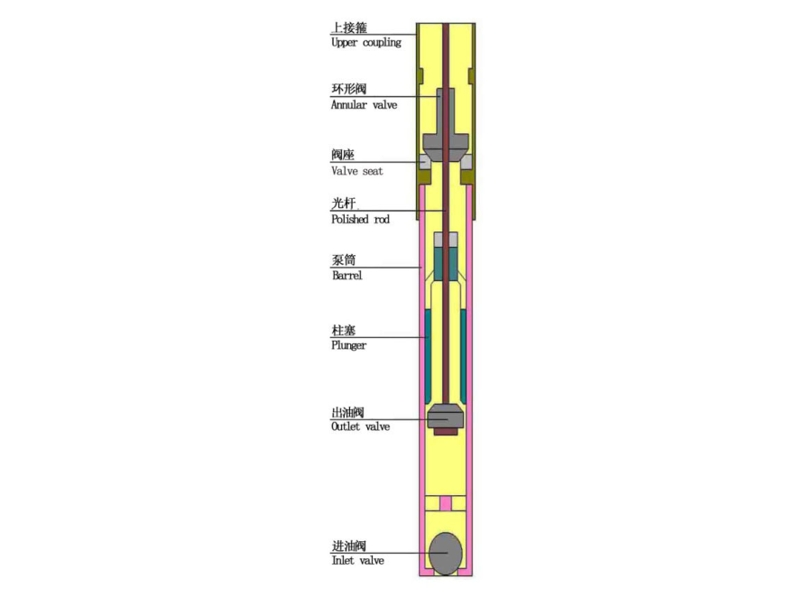
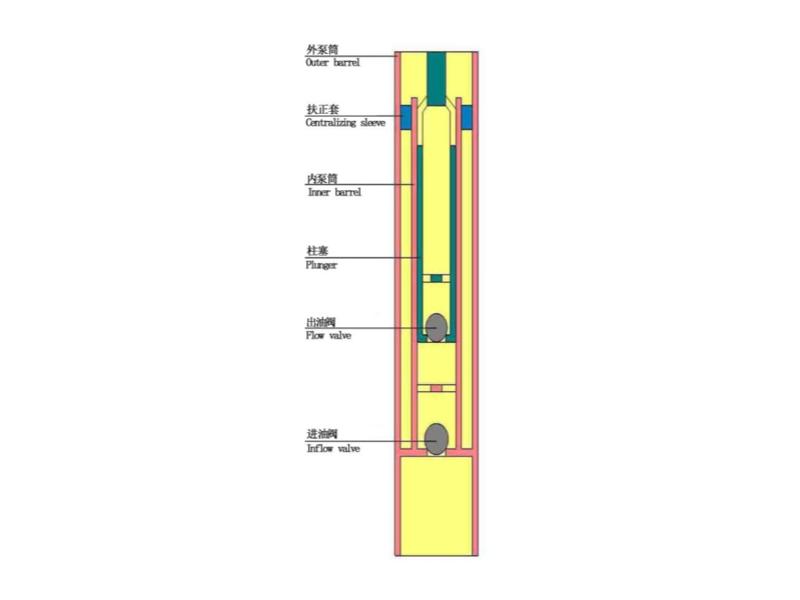
    Hydraulic feedback sucker rod pump: 1. Working principle of hydraulic feedback sucker rod pump: Hydraulic feedback sucker rod pump is composed of two pumps with different pump diameters connected in series, and the center tube connects the upper and lower plungers into one. During the upstroke, the plunger assembly moves upward, the volume of the annular cavity between the upper plunger and the lower pump barrel increases, the pressure decreases, the oil inlet valve opens, and the oil outlet valve closes under the pressure of the liquid column in the oil pipe, and the well fluid enters the annular cavity through the oil inlet/discharge joint. During the downstroke, the plunger assembly moves downward, the volume of the annular cavity between the upper plunger and the lower pump barrel decreases, the pressure increases, and the well fluid in the annular cavity closes the oil inlet valve through the oil inlet/discharge joint, the oil outlet valve opens, and is discharged into the oil pipe through the inner hole channel of the upper plunger. At this time, since the oil inlet valve is closed, the pressure of the liquid column in the oil pipe is applied to the lower plunger through the oil inlet valve (hydraulic feedback force), forcing the plunger to overcome the friction resistance of the heavy oil and move downward.
  • New Technology: Gas Locking Prevention Oil Well Pump Designed for High Gas Wells and Deviated Wells
    05-26/2025
    1. Working principle of gas locking prevention oil well pump: Gas locking prevention oil well pump is a mechanical oil production equipment, which is used for non-flowing oil well suction production, especially suitable for low permeability, light oil reservoirs, high oil-gas ratio crude oil, medium-deep inclined and pumped oil production. Generally speaking, low permeability oil fields have different degrees of "five sensitivities" (water sensitivity, acid sensitivity, salt sensitivity, alkali sensitivity, and speed sensitivity). In order to increase the production of oil wells and eliminate the damage caused by "five sensitivities" to the formation, oil formation protection measures are generally taken. One measure is to do not kill the well, which is generally used when the downhole pipe string structure is simple and the downhole tool shrinks and expands relatively small. It mainly uses downhole and ground tools and equipment to separate the environment below the wellhead and the external environment of the wellhead during the operation. However, the current domestic technology for not killing the well is not mature (it is difficult to achieve when the pressure is higher than 5MPa), and it is even more difficult to achieve when the downhole pipe string is complex, the shrinkage and expansion are relatively large. Another measure is well-killing operation, which is mainly aimed at wells with relatively high pressure and complex downhole pipes. Generally, oil layer protective agents are added to the fluid entering the well to reduce the pollution of the formation by the fluid entering the well, but the fluid entering the well will inevitably cause damage to the formation. Therefore, for various different situations, Gas locking prevention oil well pump is necessary to adopt non-killing operation methods with different scopes of use.
  • Three Major Factors That Affect the Efficiency of Deep-Well Sucker Rod Pumps. How Many Do You Know?
    05-23/2025
    There are many factors that affect pump efficiency, but from the three basic links of the deep-well sucker rod pump (the piston gives up volume, crude oil enters the pump and is discharged from the pump), it can be summarized into the following three aspects.
  • What Is a Sucker Rod Pump and How Does It Work?
    05-22/2025
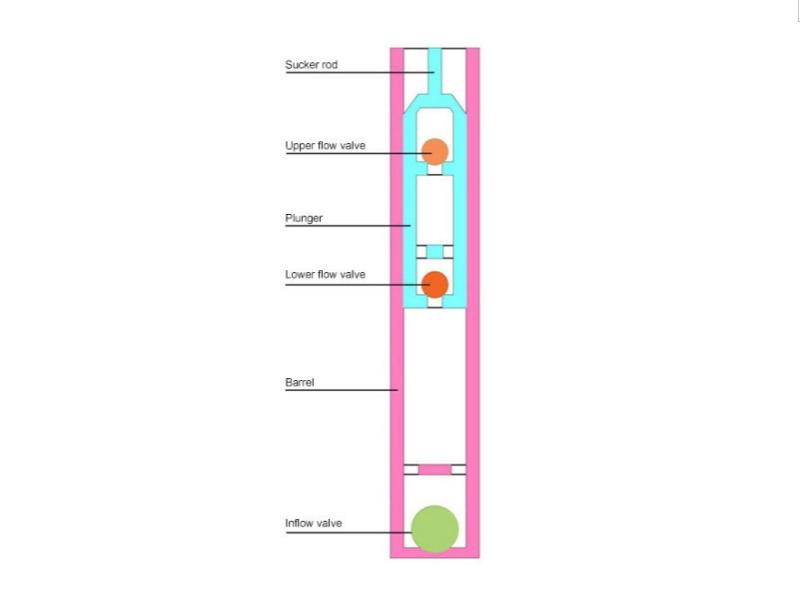
    Definition of sucker rod pump: Sucker rod pump is a common downhole device that is driven by a pumping unit to pump crude oil from the well to the ground. The ordinary sucker rod pump is mainly composed of four parts: pump barrel, suction valve, piston, and discharge valve. According to the way the sucker rod pump is fixed underground, it can be divided into tube pump and rod pump.