Get the latest price? We will reply as soon as possible (within 12 hours)

News

  • Oil Well Pump Inspection Workflow: Rod Pump Workover Guide (Part 2)
    03-12/2026
    In Part 1, we discussed the causes of pump failures and the preparation procedures required before starting an oil well pump inspection operation.
  • Oil Well Pump Inspection: Field Process Guide for Rod Pump Workover (Part 1)
    03-10/2026
    In modern oil production, the rod pumping system remains one of the most widely used artificial lift methods. However, after long-term operation, pump failures, tubing wear, and rod string damage can significantly reduce production efficiency.
  • Optimizing Multi-Layer Wells: Separate Layer Production Oil Well Pump Guide
    02-16/2026
    Introduction: Navigating the Complexity of Modern Reservoir Management In the evolving landscape of global oil extraction, the era of "easy oil" from single-strata reservoirs is rapidly concluding.
  • Special Well Pumping Pumps for Special Well Conditions
    08-16/2025
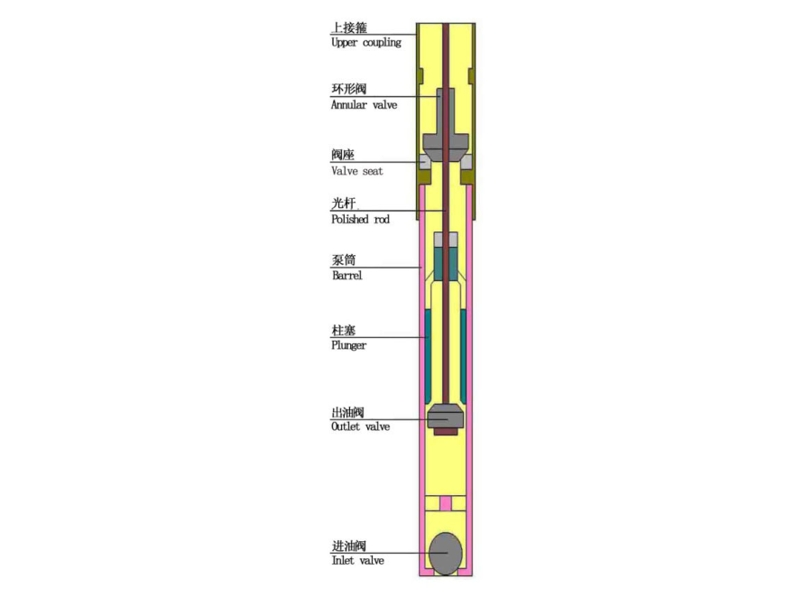
    we will take a deeper look at more details of the movable barrel sand control oil well pump. 1. Detailed explanation of the working principle of the movable barrel sand control oil well pump: During the working process of the movable barrel sand control oil well pump, during the upstroke, the sucker rod will move the movable barrel sand control oil well pump upward, causing the oil outlet valve to close. As the space in the pump barrel cavity gradually increases, the pressure begins to drop. At this time, the liquid in the well will push the oil inlet valve open and smoothly enter the pump cavity. During the downstroke, the pump barrel moves downward, and the pressure in the pump increases accordingly. The oil outlet valve opens under the action of pressure, while the oil inlet valve closes. In this way, the liquid in the pump is smoothly discharged and flows into the oil pipe.
  • Double Plunger Injection Production Oil Well Pump Solution
    08-14/2025
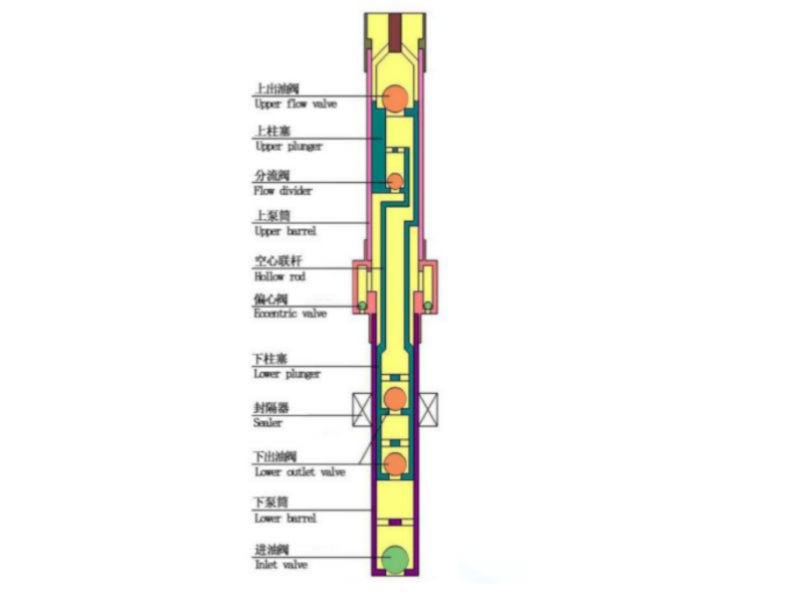
    I. Definition and Technical Positioning: A double plunger injection production oil well pump is an artificial lift device utilizing a dual-plunger positive displacement pump structure. It performs both water injection and oil recovery functions, balancing both flooding and extraction. Its double-acting plunger design enables efficient suction and discharge of liquid during both the upper and lower strokes, improving pumping efficiency and system stability. This structure, similar to a "double-acting double-plunger pump," is widely used in industrial and oilfield injection and production scenarios (Note: it does not simply suction and discharge, but rather the upper and lower plungers circulate separately).
  • How Does the Separate Layer Production Oil Well Pump Work?
    07-02/2025
    Layered oil production: Background. In view of the current situation that the oil well joint production cannot meet the production needs due to the prominent contradiction between multiple layers and layers, the layer-stuck method is generally adopted for production. The main layer-stuck pipe string structure is as follows: Control layer-production layer. Production layer-control layer. Production layer-control layer-production layer. Through the application of various layer-stuck pipe strings, the problem of inter-layer interference is effectively solved, but the full play of the production capacity of each layer of the oil well is limited. At present, there is an urgent need for a layered co-production technology that can effectively mobilize each contributing oil layer and avoid inter-layer interference, fully tap the production capacity of the oil well, increase the production of the oil well, and improve the development time.
  • Tips to Solve Problems | Solve Various Problems Encountered by Deep Well Oil Well Pump
    06-23/2025
    1. Description of the problem: When the pumping well is abnormal during the production process, it is necessary to perform maintenance inspection of the deep well oil well pump. Due to scaling, the piston of some operating oil wells is stuck in the pump barrel of the deep well oil well pump, which makes it difficult to lift it during the well repair operation. At this time, it is necessary to reverse the rod pipe. The reverse rod is reversed by 2-3 operators using pipe pliers at the wellhead. The operation is very dangerous and there have been many injuries in the past. Through on-site observation and research, the sucker rod reverser is made.
  • From Entry to Mastery: One Article to Understand the
    05-29/2025
    Hydraulic feedback sucker rod pump: 1. Working principle of hydraulic feedback sucker rod pump: Hydraulic feedback sucker rod pump is composed of two pumps with different pump diameters connected in series, and the center tube connects the upper and lower plungers into one. During the upstroke, the plunger assembly moves upward, the volume of the annular cavity between the upper plunger and the lower pump barrel increases, the pressure decreases, the oil inlet valve opens, and the oil outlet valve closes under the pressure of the liquid column in the oil pipe, and the well fluid enters the annular cavity through the oil inlet/discharge joint. During the downstroke, the plunger assembly moves downward, the volume of the annular cavity between the upper plunger and the lower pump barrel decreases, the pressure increases, and the well fluid in the annular cavity closes the oil inlet valve through the oil inlet/discharge joint, the oil outlet valve opens, and is discharged into the oil pipe through the inner hole channel of the upper plunger. At this time, since the oil inlet valve is closed, the pressure of the liquid column in the oil pipe is applied to the lower plunger through the oil inlet valve (hydraulic feedback force), forcing the plunger to overcome the friction resistance of the heavy oil and move downward.
  • New Technology: Gas Locking Prevention Oil Well Pump Designed for High Gas Wells and Deviated Wells
    05-26/2025
    1. Working principle of gas locking prevention oil well pump: Gas locking prevention oil well pump is a mechanical oil production equipment, which is used for non-flowing oil well suction production, especially suitable for low permeability, light oil reservoirs, high oil-gas ratio crude oil, medium-deep inclined and pumped oil production. Generally speaking, low permeability oil fields have different degrees of "five sensitivities" (water sensitivity, acid sensitivity, salt sensitivity, alkali sensitivity, and speed sensitivity). In order to increase the production of oil wells and eliminate the damage caused by "five sensitivities" to the formation, oil formation protection measures are generally taken. One measure is to do not kill the well, which is generally used when the downhole pipe string structure is simple and the downhole tool shrinks and expands relatively small. It mainly uses downhole and ground tools and equipment to separate the environment below the wellhead and the external environment of the wellhead during the operation. However, the current domestic technology for not killing the well is not mature (it is difficult to achieve when the pressure is higher than 5MPa), and it is even more difficult to achieve when the downhole pipe string is complex, the shrinkage and expansion are relatively large. Another measure is well-killing operation, which is mainly aimed at wells with relatively high pressure and complex downhole pipes. Generally, oil layer protective agents are added to the fluid entering the well to reduce the pollution of the formation by the fluid entering the well, but the fluid entering the well will inevitably cause damage to the formation. Therefore, for various different situations, Gas locking prevention oil well pump is necessary to adopt non-killing operation methods with different scopes of use.