

In oilfield production, selecting the wrong oil well pump for a deep well is not just a technical mistake—it directly leads to increased workover frequency, reduced production efficiency, and significantly higher operating costs.
Different reservoirs present complex challenges, including sand production, high-viscosity crude oil, gas interference, and deep well pressure conditions. A single pump type cannot perform efficiently under all these conditions.
Based on over 20 years of manufacturing and field application experience, Dongsheng Petroleum Machinery Co., Ltd. (established in 2000) has found that improper pump selection can increase failure rates by more than 30% in sand-producing wells.
This guide will help you select the right artificial lift solution based on real well conditions and compares three widely used options:
RHA Insert Rod Pump
RWB Insert Rod Pump
Tubing Pump
Oil Well Pump Selection Logic
To simplify the selection process, engineers typically evaluate four key factors:
Step 1: Well Depth
< 2500m → Insert Rod Pump (RHA / RWB)
> 2500m → Tubing Pump recommended
Step 2: Sand Content
Sand content > 0.5%–1% → RWB Pump (high sand resistance)
Low/Medium sand → RHA Pump
Step 3: Production Rate
High production (> 80–100 m³/day) → Tubing Pump
Medium/Low production → Insert Rod Pump
Step 4: Crude Oil Viscosity
Heavy oil (> 150–300 cP) → RWB Pump
Conventional crude → RHA Pump
Tip: Combining these four parameters ensures over 80% accuracy in pump selection.
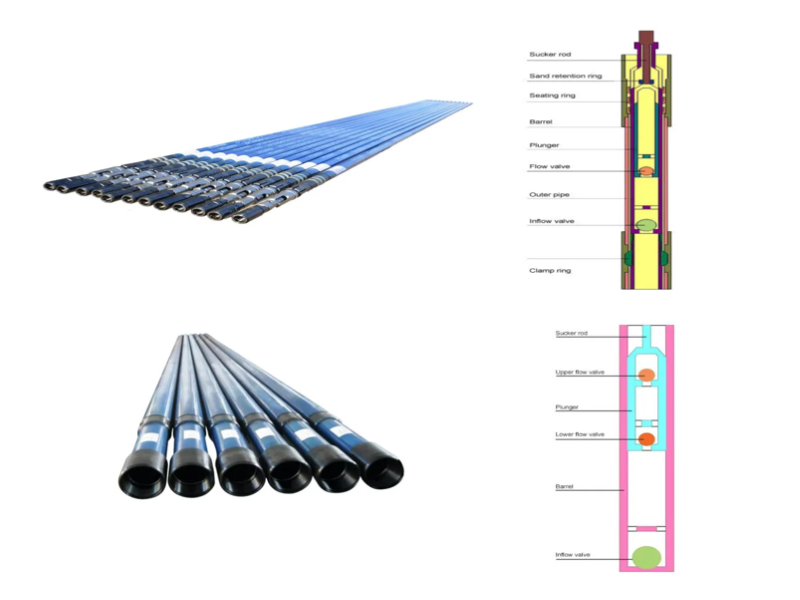
Pump Selection by Well Conditions
1. High Sand Wells
Recommended: RWB Insert Rod Pump
Why:
Designed for sand content up to 1% or higher
Anti-wear plunger and barrel materials
Reduced abrasion and longer service life
Field data shows that RWB pumps can extend service life by 20–40% in sand-producing wells compared to standard rod pumps.
2. Conventional Oil Wells
Recommended: RHA Insert Rod Pump
Why:
Cost-effective solution for standard operations
Stable performance in wells up to 2500m depth
Easy installation and maintenance
3. Deep Wells (>2500m)
Recommended: Tubing Pump
Why:
Integrated with tubing string for higher load capacity
Suitable for deep wells up to 3500m+
Improved lifting efficiency under high pressure
Compared to insert pumps, tubing pumps eliminate seating limitations and improve long-term stability in deep wells.
4. High Production Wells
Recommended: Tubing Pump
Why:
Large displacement capacity (> 100 m³/day)
Higher volumetric efficiency
Designed for continuous high-output production
5. Heavy Oil / High Viscosity Wells
Recommended: RWB Pump
Why:
Suitable for viscosity up to 300 cP or higher
Enhanced sealing reduces leakage
Improved lifting efficiency for thick fluids
RHA vs RWB vs Tubing Pump Comparison
| Feature | RHA Pump | RWB Pump | Tubing Pump |
| Installation | Inside tubing | Inside tubing | Part of the tubing string |
| Best for | Conventional wells | Sand / heavy oil wells | Deep & high-output wells |
| Sand Resistance | Medium | High (up to ~1%) | Medium |
| Production Capacity | Medium | Medium | High |
| Maintenance | Easy | Easy | Requires pulling tubing |
| Depth Suitability | ≤2500m | ≤2500m | 2500–3500m+ |
How to Select the Right Pump for Your Well
Before making a final decision, engineers should evaluate:
Well depth
Daily production rate (m³/day)
Sand content (%)
Crude oil viscosity (cP)
Gas interference level
Engineering insight:
Selecting the wrong pump type can reduce system efficiency by over 30% and significantly increase workover frequency, especially in sand or heavy oil conditions.
FAQ:
Q1: Which pump is best for high sand wells?
A: RWB insert rod pump is recommended, especially when sand content exceeds 0.5%.
Q2: Is a tubing pump suitable for shallow wells?
A: No. It is more cost-effective for deep wells with higher production requirements.
Q3: What is the difference between RHA and RWB pumps?
A: RHA is for conventional wells, while RWB is optimized for sand and high-viscosity oil.
Q4: Can pumps be customized for corrosive wells?
A: Yes. Materials such as alloy steel or special coatings can be applied for H₂S or CO₂ environments.
Need Help Selecting the Right Pump?
Choosing the right oil well pump requires both engineering expertise and field experience.
At Dongsheng Petroleum Machinery Co., Ltd., we provide:
Customized pump selection based on your well data
OEM / ODM manufacturing solutions
Send us your well parameters (depth, production rate, sand content, viscosity), and our engineers will recommend the most suitable pump model within 24 hours.