
Introduction: Navigating the Complexity of Modern Reservoir Management
In the evolving landscape of global oil extraction, the era of "easy oil" from single-strata reservoirs is rapidly concluding. Today, petroleum engineers and B2B procurement specialists are increasingly confronted with multi-layered reservoirs where different strata exhibit vastly different pressures, fluid viscosities, and water cuts. To maximize the Return on Investment (ROI) and extend the economic life of these assets, the industry has turned to a sophisticated solution: the separate-layer production oil well pump.
At DongSheng, we recognize that for B2B buyers—importers, wholesalers, and OEM partners—the selection of downhole equipment is a high-stakes decision. You aren't just buying a tool; you are investing in a technology that prevents cross-flow, manages reservoir energy, and optimizes production efficiency. This guide provides a deep technical dive into why the Separate layer production oil well pump is the definitive choice for complex well completions.
1. What is a Separate Layer Production Oil Well Pump?
The Core Concept
A Separate layer production oil well pump is a specialized artificial lift system designed to produce fluid from two or more oil-bearing layers simultaneously within a single wellbore, while maintaining hydraulic isolation between them. In traditional commingled production, fluid from multiple layers is mixed at the bottom of the hole. However, if one layer has significantly higher pressure than another, the high-pressure fluid can "invade" the lower-pressure layer (cross-flow), leading to reservoir damage and lost production.
How It Works: Technical Mechanics
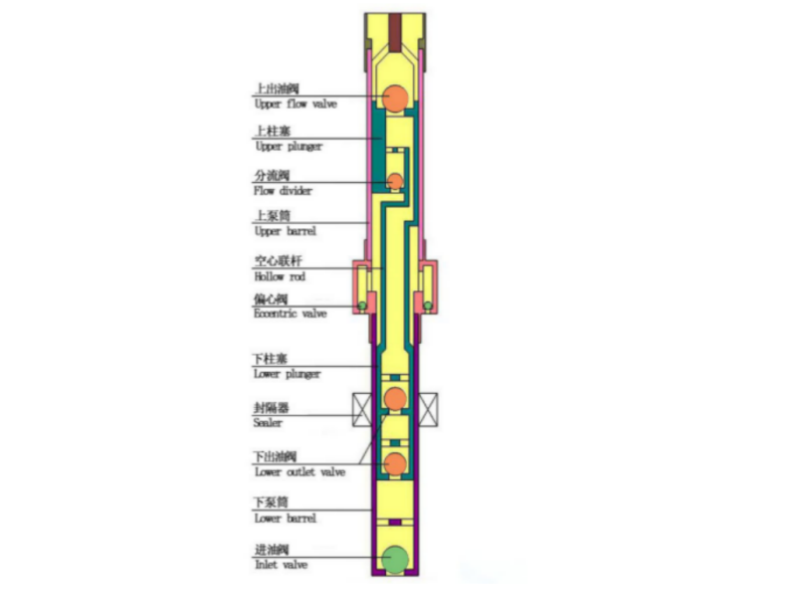
The separate production system typically utilizes a series of packers, specialized valves, and often a dual-plunger or multi-stage pump design.
Zonal Isolation: Packers are set to isolate the different oil-bearing strata.
Selective Intake: The pump features multiple intake ports. Fluid from the lower layer enters through the bottom, while fluid from the upper layer enters through a side-intake or specialized mandrel.
Pressure Management: Specialized check valves ensure that fluid only moves in one direction—up toward the surface—preventing the "pressure thief" scenario where oil moves from high-pressure zones to low-pressure zones.
2. Technical Advantages: The DongSheng Authority
As a leading manufacturer, our Separate layer production oil well pump is engineered to meet the highest API standards, ensuring that our B2B partners receive a product backed by rigorous testing and field-proven reliability.
Elimination of Cross-Flow (Inter-Layer Interference)
The most significant technical advantage is the prevention of cross-flow. By isolating layers, the pump allows each stratum to produce according to its own natural energy. This is critical for reservoirs where a high-water-cut layer might otherwise "kill" the production of a high-oil-cut layer.
Customized Volumetric Efficiency
Our pumps allow for the adjustment of displacement for different layers. By varying the plunger size or stroke length, we can tailor the extraction rate to the productivity index of each specific layer, ensuring that we don't over-pump a low-productivity zone while leaving oil behind in a high-productivity one.
Advanced Metallurgy and Longevity
Drawing from our extensive product knowledge at dsrodpump.com, we utilize premium materials:
Chrome-Plated Barrels: For superior wear resistance in sandy conditions.
Nickel-Alloy Plungers: To resist corrosion in H2S or CO2-rich environments.
Tungsten Carbide Valves: To ensure a perfect seal even after millions of cycles.
3. Critical Questions & Concise Answers
For the B2B buyer, the "bottom line" is functionality and reliability. Here are the questions we hear most often from our global partners:
Q: Can this pump handle layers with widely different pressures?
A: Yes. The mechanical isolation via packers and check valves ensures the high-pressure layer cannot feed into the low-pressure layer.
Q: Is it difficult to install compared to a standard pump?
A: It requires more precise packer placement, but the pump itself is designed for standard API rod string compatibility, making the surface operation identical to conventional systems.
Q: What is the typical ROI for a separate production system?
A: Most operators see a 15-30% increase in total well recovery and a significantly longer well life, often paying for the equipment within the first 6 months of production.
Q: Can we order these as OEM for our own brand?
A: Absolutely. DongSheng specializes in OEM manufacturing, providing custom branding, specialized metallurgy, and proprietary designs for our wholesale partners.
4. Scenario Analysis: When to Use Separate Production
Scenario A: High-Pressure vs. Low-Pressure Strata
In mature fields, secondary recovery (like water flooding) often creates high-pressure zones adjacent to depleted low-pressure zones. A standard pump would cause the high-pressure water to flood the low-pressure oil zone.
The Solution: The Separate layer production oil well pump allows you to harvest oil from the low-pressure zone while simultaneously managing the high-pressure zone, preventing reservoir contamination.
Scenario B: Differentiated Water Cuts
One layer may be producing 90% water, while another is producing 10% water. Mixing them at the bottom hole increases the "water-cut" of the entire stream, increasing lifting costs and surface treatment expenses.
The Solution: Separate production allows for selective pumping or even "downhole water separation," where the water-heavy stream is handled differently than the oil-heavy stream.
5. Selection Essentials: Matching the Tool to the Well
Choosing the right Separate layer production oil well pump requires a deep understanding of the well's "personality." B2B buyers should focus on the following:
Casing and Tubing Size: Ensure the pump and packers have enough clearance (OD) for the casing while maintaining a large enough ID (Internal Diameter) for the desired production volume.
Plunger Fit: In high-temperature wells, thermal expansion must be calculated to prevent plunger sticking. We offer customized "fit" tolerances for every order.
Seating Depth: The pump must be seated at an optimal depth to maintain the hydrostatic head required for zonal isolation.
6. Technical Parameter Suggestions for Procurement
Parameter | Standard Well Recommendation | Harsh/Corrosive Well Recommendation |
Material | Carbon Steel / Chrome Plating | Stainless Steel / Nickel-Carbide |
Plunger Type | Spray Metal (SM) | Hardened Steel / Tungsten Coating |
Valve Type | Stainless Steel Ball/Seat | Ceramic or Tungsten Carbide |
Packer Type | Mechanical Set | Hydraulic Set / High-Temp Seals |
7. Common Mistakes in Separate Layer Production
Incorrect Packer Placement: If the packers are not set precisely at the impermeable layer between the oil zones, communication will occur, and the Separate layer production oil well pump will lose its primary advantage.
Mismatched Stroke Speed: Running the pump too fast can create a vacuum in low-productivity layers, leading to "fluid pound" and mechanical damage to the rod string.
Neglecting Chemical Compatibility: Using standard elastomers in a well with high CO2 will cause seals to swell and fail. Always specify the gas and chemical profile of the well during procurement.
Product FAQ: Separate layer production oil well pump Support
Q1: How does the "Separate layer production oil well pump" reduce overall lifting costs (OpEx)?
A: By preventing cross-flow and maximizing the production of the most profitable oil-bearing layers, you reduce the amount of energy wasted on recirculating fluids downhole. It also reduces the frequency of workovers caused by reservoir damage.
Q2: Can we customize the pump length for extra-long stroke units?
A: Yes. We can manufacture barrels and plungers up to 30+ feet to accommodate high-volume surface units, ensuring that you maximize displacement per stroke.
Q3: What certifications do DongShengs carry?
A: All our Separate layer production oil well pumps are manufactured in accordance with API 11AX standards and ISO 9001 quality management systems, ensuring global compliance for international B2B importers.
Q4: How do you handle shipping for long-barrel pumps?
A: We use reinforced, rust-preventative packaging and heavy-duty wooden crates to ensure that even the longest Separate layer production oil well pumps arrive at your facility perfectly straight and free of corrosion.
Conclusion: Elevating Your Production Strategy
In the competitive arena of B2B oilfield supply, the Separate layer production oil well pump stands as a pinnacle of technical ingenuity. It is the tool of choice for the modern operator who refuses to leave oil behind. By effectively managing reservoir energy, preventing costly inter-layer interference, and providing a platform for customized extraction, this technology represents a significant leap forward in artificial lift efficiency.
For B2B partners, choosing DongSheng means choosing a legacy of engineering excellence. We provide the expertise, the quality control, and the OEM flexibility required to thrive in today’s complex energy market. Don't just pump oil—manage your reservoir with the precision of separate production.