Get the latest price? We will reply as soon as possible (within 12 hours)

Blog

  • What Oil Producers Should Consider Before Purchasing an Oil Rod Pump in 2025
    12-04/2025
    Introduction: Why Choosing the Right Oil Rod Pump Matters More Than Price: In most onshore oilfields, oil rod pumps remain one of the most common and cost-effective artificial lift methods. For procurement and operations teams, selecting the right oil rod pump is not just about buying equipment. It directly affects well production, downtime, maintenance workload, and long-term costs. One wrong choice can lead to frequent pump inspections, high operating expenses, and even long-term impacts on daily production stability. This article provides a systematic framework for evaluating and selecting an oil rod pump from a corporate procurement perspective. We cover well assessment, fluid properties, materials and manufacturing, lifecycle cost (LCC/TCO), supplier evaluation, procurement processes, and risk control. We also provide a practical checklist to help teams balance technical and commercial factors, avoiding extremes of “expensive but unnecessary” or “cheap but failure-prone.”
  • Analysis of Factors Affecting Pump Inspection Cycles in Oil Wells and Recommended Countermeasures
    12-04/2025
    1.1 Analysis of Pump Inspection Causes: Casing failure has produced the biggest number of Deep-Well Sucker Rod Pump issues which lead to more than 50% of all pump inspections. Among these, the major causes are the broken traveling valve cover, pump leakage, and the bleeder problems. The traveling valve cover is the one that connects the sucker rod and the Sucker Rod Pump and at the same time assures that liquid is pumped out from the piston. The upward pull of the sucker rod, the weight of the sucker rod itself, and the friction between the pump barrel and the piston are the factors that the cover faces during production.
  • How to Diagnose an Oil Well and Keep Your Sucker Rod Pump Running Smoothly
    12-01/2025
    When something feels “off” on a well site, engineers usually don't start with paperwork. They start by checking the wellhead pressure and sound. These two things reveal more about a well's condition than most dashboards and reports. Below is a practical guide based on our field experience and overseas service work with customers in the Middle East, South America, Africa, and Central Asia.
  • How to Combine Artificial Lifting Methods?
    11-29/2025
    We’ve worked on enough wells to know that choosing a single artificial lift method and expecting it to carry a well from day one to abandonment seldom works. Reservoirs shift, fluids change temperament, gas sneaks in when you least expect it, and occasionally the tubing throws surprises no model predicted. Over time, our team has learned that the most stable wells are usually those where we combine lift methods—sometimes intentionally, and sometimes simply because the well forces us to do so. Below is a practical look at why hybrid lift systems matter and how engineers actually apply them in the field, far away from the neat diagrams in textbooks.
  • Selection Method of Sucker Rod Pump and its Matching Tools
    11-28/2025
    How to Select a Sucker Rod Pump: Well data to be collected before pump selection: a) Oil layer depth, effective thickness, effective permeability; b) Casing specifications, well inclination, azimuth, well bends, and other technical conditions; c) Well fluid production index, static fluid level, dynamic fluid level; d) Crude oil surface and underground viscosity, and well sand production, wax deposition, scaling, and corrosion; e) Well production, water cut, gas-oil ratio, and other production conditions; f) Well production history.
  • Sucker rod pump oil extraction technology includes:
    11-26/2025
    Sucker rod pumping is the most common artificial lift method both domestically and internationally: Venezuela: 70% of oil wells are pumped using rod pumps. The United States: 85% of oil wells are pumped using rod pumps. Russia: Over 55% of oil wells are pumped using rod pumps. China: Over 80% of oil wells use sucker rod pumps, accounting for 75% of total oil production. Rod pumps play a crucial role in my country's oil extraction.
  • What Are the Operating Methods of a Tubing Pump?
    11-25/2025
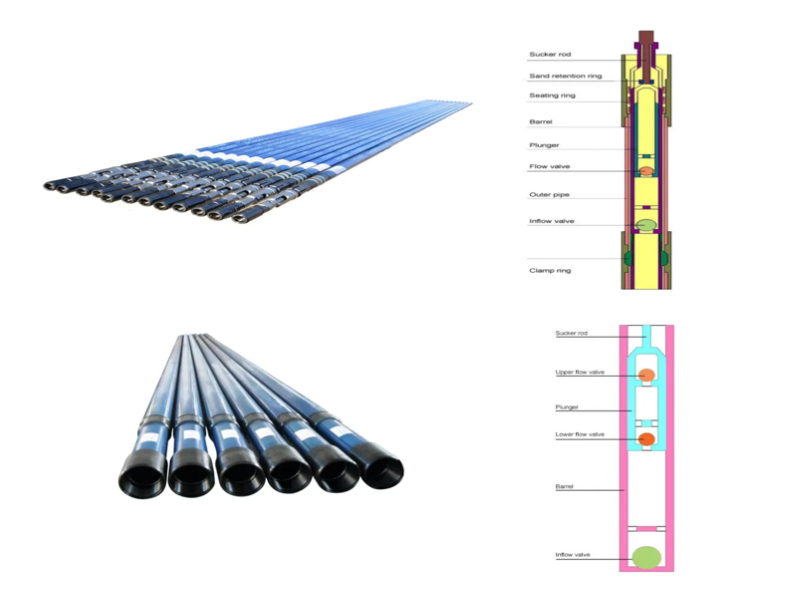
    The importance of the sucker rod pump: Although it accounts for a small proportion of the total cost and weight of a complete rod-operated pumping unit, it is a key component determining the technical and economic indicators of the unit. The operating condition of the sucker rod pump significantly affects the service life of the surface pumping unit and sucker rod. Factors such as plunger jamming, delayed opening and closing of pump valves, and excessive pump clearance volume can all cause overload and malfunction of the pumping unit and sucker rod, leading to well collapse. A schematic diagram of the structure and operation of a sucker rod pump is shown in the figure.
  • Judgment and Countermeasures for Oil Well Failures
    11-24/2025
    With the continuous extension of oil well development time and the increase in oilfield production projects, coupled with the high complexity of the oil reservoir environment and the year-round operation of oil wells, the types of oil well failures have become more complex. The following section uses the surface engineering of oil wells as an example to analyze common oil well failures and corresponding countermeasures.
  • Tubing Pump and its Applications in Oil Wells
    11-22/2025
    1.Overview of Tubing Pumps: Common Pump Types: Commonly used pumps in oil wells include tubing pumps, screw pumps, and ESPs. This article mainly introduces tubing pumps. Tubing PumpStructure: It mainly consists of a working barrel, bushing, fixed valve, piston, traveling valve, and clamping clamp. The working barrel contains a bushing, which is fixed at both ends with clamping clamps. Conventional tubing pumps are bushed pump barrels, metal plunger pumps, available in various diameters of 38, 44, 56, 70, 83, and 95 mm, with strokes of 3m and 5m.
  • Artificial Lift Comparison
    11-21/2025
    Artificial lifting is a process where, when the natural energy of the formation is insufficient to sustain natural flow production, or although natural flow is possible but the production rate is insufficient, mechanical equipment is installed in the wellbore to work on the fluid, allowing it to flow to the surface.