
Get the latest price? We will reply as soon as possible (within 12 hours)

Blog

  • What Kind of Tubing Pump Should be Selected for Onshore Oil Recovery
    06-02/2025
    Oil recovery is a complex process that varies depending on the environment. The three main environments for oil recovery are onshore, offshore, and unconventional reservoirs. Today we will talk about what kind of sucker rod pump should be used for onshore oil recovery.
  • How to Correctly Lower the API Rod Pump?
    05-30/2025
    The API rod pump is one of the equipment in the artificial lifting system of the oil well. The lowering process is directly related to the stable operation and production efficiency of the entire oil production system. In order to reduce the occurrence of downhole failures and extend the service life of the equipment, standardized lowering operation cannot be ignored. This article combines our product features and industry experience to systematically explain the API rod pump lowering operation procedure and give a reasonable explanation for each operation.
  • From Entry to Mastery: One Article to Understand the
    05-29/2025
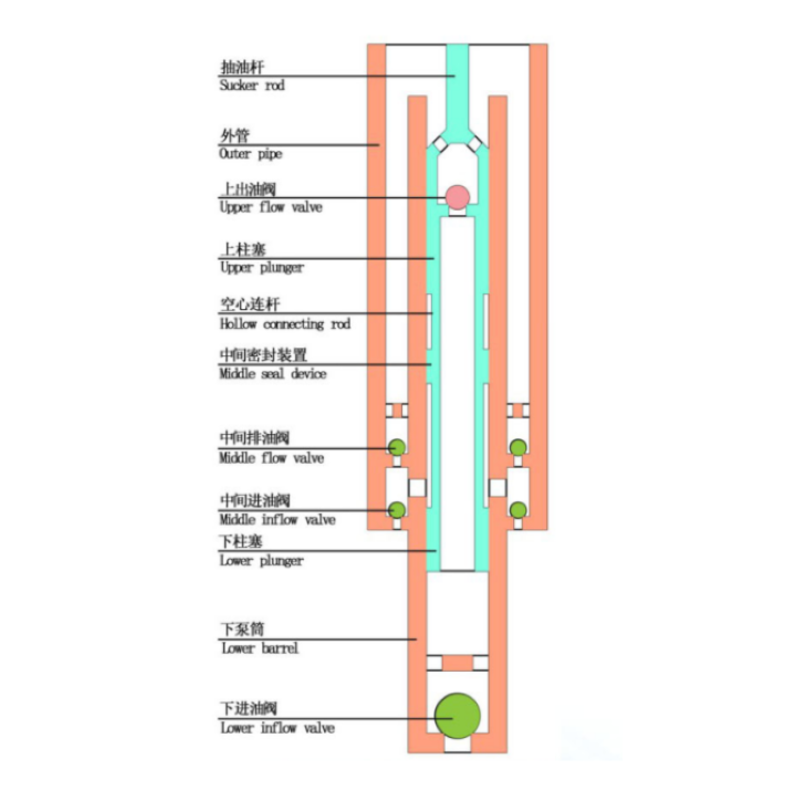
    Hydraulic feedback sucker rod pump: 1. Working principle of hydraulic feedback sucker rod pump: Hydraulic feedback sucker rod pump is composed of two pumps with different pump diameters connected in series, and the center tube connects the upper and lower plungers into one. During the upstroke, the plunger assembly moves upward, the volume of the annular cavity between the upper plunger and the lower pump barrel increases, the pressure decreases, the oil inlet valve opens, and the oil outlet valve closes under the pressure of the liquid column in the oil pipe, and the well fluid enters the annular cavity through the oil inlet/discharge joint. During the downstroke, the plunger assembly moves downward, the volume of the annular cavity between the upper plunger and the lower pump barrel decreases, the pressure increases, and the well fluid in the annular cavity closes the oil inlet valve through the oil inlet/discharge joint, the oil outlet valve opens, and is discharged into the oil pipe through the inner hole channel of the upper plunger. At this time, since the oil inlet valve is closed, the pressure of the liquid column in the oil pipe is applied to the lower plunger through the oil inlet valve (hydraulic feedback force), forcing the plunger to overcome the friction resistance of the heavy oil and move downward.
  • New Technology: Gas Locking Prevention Oil Well Pump Designed for High Gas Wells and Deviated Wells
    05-26/2025
    1. Working principle of gas locking prevention oil well pump: Gas locking prevention oil well pump is a mechanical oil production equipment, which is used for non-flowing oil well suction production, especially suitable for low permeability, light oil reservoirs, high oil-gas ratio crude oil, medium-deep inclined and pumped oil production. Generally speaking, low permeability oil fields have different degrees of "five sensitivities" (water sensitivity, acid sensitivity, salt sensitivity, alkali sensitivity, and speed sensitivity). In order to increase the production of oil wells and eliminate the damage caused by "five sensitivities" to the formation, oil formation protection measures are generally taken. One measure is to do not kill the well, which is generally used when the downhole pipe string structure is simple and the downhole tool shrinks and expands relatively small. It mainly uses downhole and ground tools and equipment to separate the environment below the wellhead and the external environment of the wellhead during the operation. However, the current domestic technology for not killing the well is not mature (it is difficult to achieve when the pressure is higher than 5MPa), and it is even more difficult to achieve when the downhole pipe string is complex, the shrinkage and expansion are relatively large. Another measure is well-killing operation, which is mainly aimed at wells with relatively high pressure and complex downhole pipes. Generally, oil layer protective agents are added to the fluid entering the well to reduce the pollution of the formation by the fluid entering the well, but the fluid entering the well will inevitably cause damage to the formation. Therefore, for various different situations, Gas locking prevention oil well pump is necessary to adopt non-killing operation methods with different scopes of use.
  • Three Major Factors That Affect the Efficiency of Deep-Well Sucker Rod Pumps. How Many Do You Know?
    05-23/2025
    There are many factors that affect pump efficiency, but from the three basic links of the deep-well sucker rod pump (the piston gives up volume, crude oil enters the pump and is discharged from the pump), it can be summarized into the following three aspects.
  • What Is a Sucker Rod Pump and How Does It Work?
    05-22/2025
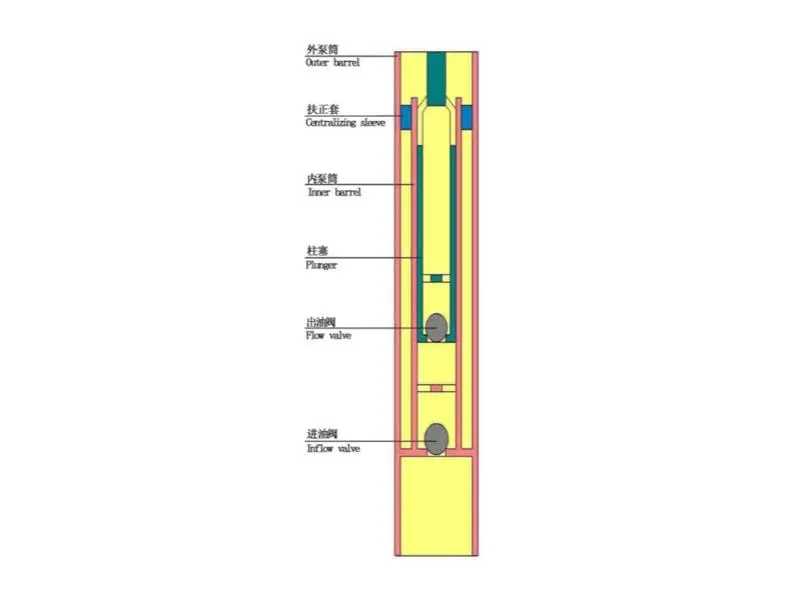
    Definition of sucker rod pump: Sucker rod pump is a common downhole device that is driven by a pumping unit to pump crude oil from the well to the ground. The ordinary sucker rod pump is mainly composed of four parts: pump barrel, suction valve, piston, and discharge valve. According to the way the sucker rod pump is fixed underground, it can be divided into tube pump and rod pump.
  • Discussion on the Treatment Method of Pump Barrel Leakage
    05-10/2025
    In the process of crude oil extraction, sucker rod pump barrel leakage is a common problem, which not only causes delays and energy waste, but also may cause problems such as liquid hammer and vibration, and accelerate the damage of components such as plungers and valve groups. Pollute the well site environment and even cause fire hazards. So, what causes pump barrel leakage? How should we effectively reduce pump barrel leakage?
  • Sucker Rod Pump Structure Type and Specific Parameters
    05-08/2025
    Due to the continuous development of industry and economy, the exploitation of oil wells has continued to increase, and the demand for sucker rod pumps has also continued to increase. Sucker rod pump is the main equipment in the rod pumping system. Depending on the depth of the oil well, production capacity, and crude oil properties, the required type of sucker rod pump structure will also be different.
  • Do You Know How API Sucker Rod Pump Works in Oil Fields?
    05-04/2025
    In the actual oil production process of API sucker rod pump, the coordinated reciprocating motion of pump barrel and plunger is the key. This motion not only determines the displacement of API sucker rod pump, but also is affected by multiple factors such as plunger outer diameter, pump barrel inner diameter, pressure, temperature and axial force, which together determine the service life of API sucker rod pump. This article will take you to understand the working principle of API sucker rod pump in depth, thereby improving your efficiency in oil production.
  • Tube Pump Vs. Rod Pump, Which one Should you Choose?
    05-03/2025
    In the world of oilfield exploitation, the oil well pump is like the "heart" of the oil well. Its performance determines the output and exploitation efficiency of crude oil. Among the many oil well pumps, the competition between API tubing rod pumps and API sucker rod pumpshas never stopped. One has a simple structure and large displacement, while the other is convenient for pump inspection and adaptable to deep wells. But what are their advantages and disadvantages? Which pump is more suitable for your oil well? Today, we will analyze these two oil well pumps in depth!