Get the latest price? We will reply as soon as possible (within 12 hours)

News

  • 100 Q&As on Oil Production Basics (Part 1)
    09-01/2025
    We have compiled "100 Q&As on Oil Production Basics," which uses a question-and-answer format to organize and summarize key knowledge points about oil and gas fields. This is Part 1, covering questions 1-50. The content covers core knowledge such as the basic concepts of oil and gas fields, production wells and oil production methods, pumping unit and progressive cavity pump operation, water injection and flooding methods, and oil well operation and maintenance.
  • Basic Characteristics of Shale Oil
    09-01/2025
    Definition of Shale Oil: Shale oil refers to petroleum stored in organic-rich, nanoscale pore-bearing shale formations. It is the abbreviation for mature organic shale oil. Shale is both a source rock and a reservoir rock for oil. Shale oil exists in adsorbed and free forms and is generally light in weight and low in viscosity. It is primarily stored in nanoscale pore throats and fracture systems, distributed along or parallel to lamellae. Organic-rich shales generally accumulate over large, continuous areas in the center of a basin, are generally oil-bearing, and have a large resource size. Key factors in evaluating the "core zone" of shale oil include reservoir space distribution, reservoir brittleness index, shale oil viscosity, formation energy, and the size of the organic-rich shale. The successful extraction of shale gas provides a technical reference for shale oil extraction. "Artificial permeability" stimulation technologies, such as horizontal well volume fracturing and refracturing, are key technologies for the effective development of shale oil. Among shale oil resources, condensate oil or light oil may be the primary types for industrial production [6,11]. Condensate and light oil molecules have a diameter of 0.5 to 0.9 nm. Theoretically, they are more easily flowable and recoverable within the nanoscale pore throats of shale under high temperature and high pressure underground.

  • API Rod Pump Applications in Unconventional Resource Wells
    08-31/2025
    Like all artificial lift systems, API Rod Pumps are used to restore production when the reservoir's natural driving energy is insufficient to bring oil and gas to the surface. Operators are now applying this proven technology to unconventional resources that have only recently become economically and technically viable.
  • How to Use an Inclined Well Sucker Rod Pump
    08-31/2025
    I. Overview of the Inclined Well Sucker Rod Pump: During oilfield production, due to formation structure and specific conditions, oil well pumps operate in wells with a certain inclination. Using conventional pumps can cause valve closure lag, resulting in lower pump efficiency and increased production costs. To address this issue, we developed the Inclined Well Sucker Rod Pump, which addresses the issue of valve ball closure lag and improves pump efficiency.
  • Three Common Oil Recovery Methods
    08-30/2025
    After exploration, drilling, and completion, the well begins normal production, and the oil field enters the production phase. Based on the needs of the oil field, the goal is to maximize the extraction of underground crude oil to the surface, increase well production and oil recovery, and rationally develop the reservoir to achieve high and stable production. This is called oil recovery.
  • How to Clean API Rod Pumps and API Tubing Pumps?
    08-30/2025
    For this reason, "how to efficiently and economically clean oil well pumps" has become a crucial concern for oil production plants, service companies, and even every on-site worker. Drawing on field experience and industry practices, we have compared and summarized the cleaning methods for API rod pumps and API tubing pumps.
  • The Difference Between Tubing and Pump Leakage in Pumping Units
    08-29/2025
    During the operation of a pumping unit system, leakage is a common problem that affects production efficiency and equipment life. While "tubing leakage" and "pump leakage" are often mentioned, many people tend to confuse them. This article will systematically explain the differences between the two from four perspectives: definition, causes, impacts, and solutions, to help users quickly understand and diagnose the problem.
  • Factors Affecting API Tubing Pump Efficiency
    08-29/2025
    The production of a well often depends not only on the oil supply capacity of the oil layer itself, but also on the performance of the pump efficiency. The pump efficiency directly determines whether the unit energy consumption can be converted into more crude oil output. There are many factors that affect the API tubing pump efficiency, but from the three basic links of deep well pump operation (piston volume, crude oil entering the pump and crude oil being discharged from the pump), it can be summarized into the following three aspects.
  • API Tubing Pump Purchasing Guide
    08-28/2025
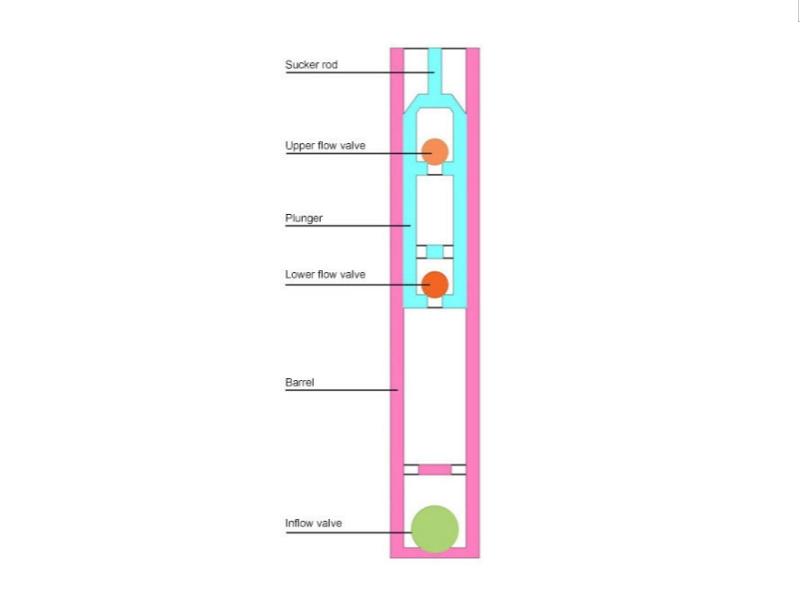
    1. API Tubing Pump Definition and Principle: API tubing pump: The pump barrel is fixed to the lower end of the tubing, and the sucker rod drives the plunger back and forth to achieve suction and discharge. Compared to insert pumps (in which the pump barrel and plunger can be pulled and retracted as a single unit), API tubing pumps have thicker barrels, are more pressure-resistant, and more wear-resistant. However, this comes at the cost of requiring the tubing to be pulled for maintenance, making them less accessible.
  • API Tubing Pumps: Essential Tools for the Oil Industry
    08-28/2025
    Designed in strict compliance with API 11AX standards, API tubing pumps utilize a one-piece rough barrel and precision grinding to ensure a precise fit with the plunger. They utilize high-strength construction, wear-resistant alloy materials, and modular wear parts.