

This paper investigates the running of deep well sucker rod pumps during different complex working conditions. It mainly describes the modular and double-layer pump barrel design features, their benefits in field stability, and the real competition of Chinese manufacturing in the API standard system and the world market. The content is very informative and provides technical analyses plus tips on how to choose for engineers and purchasers.
I. Modular Design Facilitates Field Maintenance and Universal Replacement
A modular design concept is used throughout the design of the thin-layer oil well suction pump. The pump barrel, plunger, and valves, among other core elements, are standard independent modules by themselves. The disassembly and replacement of the structure are made easier with this layout, thereby reducing on-site downtime and raising maintenance efficiency. Besides, the modularity feature enables on-site maintenance work to be carried out with regular oilfield tools; thus, no special equipment is necessary. This is all the more necessary for the quick resolution of downhole faults.
Besides enhancing the convenience of maintenance, the modular design also helps to simplify inventory management at the site, thereby allowing a more flexible combination of spare parts for various oil well conditions and at the same time, lowering the overall operating costs.
II. Double-Layer Pump Cylinder Structure Improves Efficiency and Sealing Stability
The double-layer pump cylinder structure is the key feature of the new deep-well sucker rod pump. It basically resolves the problems of leakage and efficiency loss of a normal single-layer pump in deep-well conditions. The working principle is: when the pump is in the upstroke mode, the hydrostatic pressure of the wellbore liquid column inside acts on the outer wall of the pump cylinder thereby reducing the gap between the pump barrel and the plunger; thus, the efficiency loss caused by media leakage is minimized. In the downstroke phase, the internal and the external pressures almost equalize, thus the "pump body expansion" is avoided, which, at least via the primary level, is the reason for reduced fatigue damage, hence the extended service life and lowered maintenance frequency.
The double-layer pump barrel structure provides better sealing and resistance to deformation in deep high-pressure wells, making it more preferable for deep wells and low-production wells.
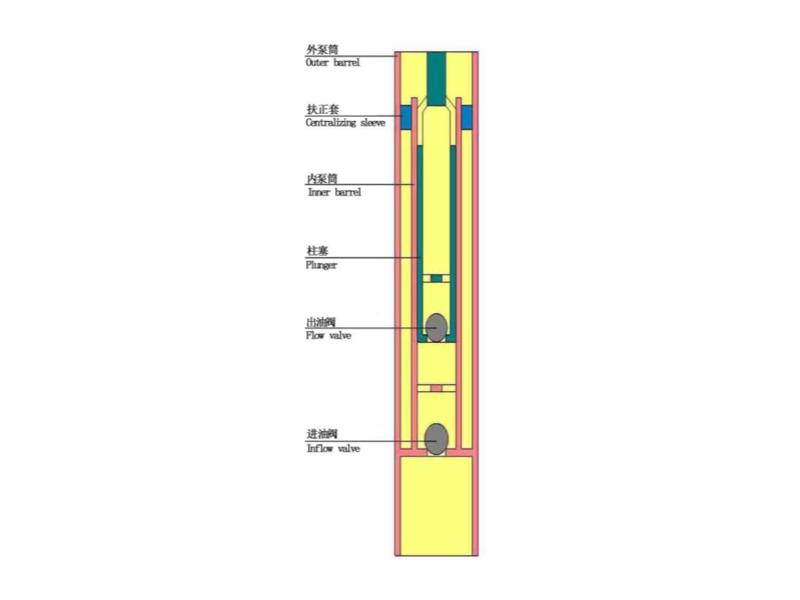
III. Anti-Stuck Plunger Structure Improves Operational Stability
The deep-well sucker rod pump's special anti-stuck plunger design directly reacts with the presence of little sand and mechanical impurities inside the well. This kind of structure enables the sucker rod pump downhole to follow the inclusions automatically and release them in case of encountering small impurities, thus the plunger jamming issues are greatly lowered. Field data already disclose that if the equipment is operated under a specific set of conditions, then the plunger sticking problems can be reduced by more than 80% thanks to this design.
This technique is critical for oil wells with sand and are rich in impurities to enhance the continuous operating time of the whole system.
IV.System Structure and Working Logic Overview
A typical deep well sucker rod pump basically comprises an outer cylinder, a centralizer, an inner cylinder, a flow valve, and an inlet valve. The outer and inner cylinders constitute a double-layer sealing system together. The centralizer functions to maintain the pump body perpendicular so as to lessen friction of the wellbore wall; the flow valve governs the direction of the fluid being pumped, whereas the inlet valve stops the backflow of fluid within the pump compartment. These components, among other things, ensure the smooth running of the entire pump system.
The structural design largely focuses on conformity to the API standards (e.g., API 11AX, which outlines the requirements of pump component dimensions and materials) so as to achieve product versatility and reliability. The API 11AX standard details the dimensions and material requirements for pump units and components, thus assisting manufacturers in ensuring component interchangeability and standardization.
V. Global Competitiveness of Chinese Manufacturing and the Background of API Standards
Today, China has become a major supplier of sucker rod pumps globally. It has a well-developed steel and alloy materials industry that provides raw materials for producing high-quality pump parts, which are strongly demanded and exported to the Middle East, South America, and Central Asia. The major reasons are high cost-effectiveness, manufacturing capabilities in accordance with industry standards such as API 11AX/API 11B, and vast field export experience.
The API 11AX standard specifies the dimensions and material requirements for submersible rod pump components and accessories, thus facilitating the standardization and interchangeability of components in oilfields worldwide, and improving the ease of procurement.
At the same time, the use of proper materials, such as high-wear-resistant coatings and alloy steel plungers, can help the equipment to adapt to complex well conditions and thus prevent premature aging or damage resulting from material incompatibility.
In the face of complicated deep well conditions, a thorough comprehension of the structural design principles, maintenance conveniences, and standardization requirements of sucker rod pumps gives engineers and purchasers the opportunity to be more in the know when it comes to choosing equipment. This product is instrumental in raising pump efficiency and operational stability through modular design, double-layer pump barrel structure, and anti-jamming technology, while it also meets API standards for ensuring global oilfield compatibility and dependable delivery.