

For oilfield procurement managers and engineering supervisors, the cost of a sucker rod pump itself represents only a small fraction of total well operating expenses (OPEX). The real cost driver is unplanned workovers. Each downtime caused by pump failure can result in tens of thousands of dollars lost in production and service costs.
Dongsheng Petroleum Machinery, a trusted manufacturer of API 11AX-compliant subsurface rod pumps, leverages years of production and field data, combined with industry benchmarks, to provide this practical guide for selecting pumps that maximize reliability and efficiency in sandy, corrosive, or high-viscosity wells.
1. Why Standard Pumps Often Fail Early: Common Failure Modes
In demanding well environments, conventional API 11AX rod pumps frequently fall short of expected service life. Field studies across multiple South American heavy-oil operations, supported by the International Association of Drilling Contractors (IADC) artificial lift survey, show that premature failures usually occur due to:
| Failure Mode | Approx. Contribution | Description |
| Sand Abrasion | ~30% | Sand particles enter the clearance between the plunger and barrel, causing scoring and accelerated wear. |
| Valve Leakage | ~25% | Valve balls and seats wear or corrode, reducing volumetric efficiency. |
| Chemical Corrosion | ~20% | H₂S or CO₂ causes localized pitting and material degradation. |
| Gas Lock | ~15% | High gas-oil ratio prevents the pump chamber from filling completely, drastically lowering pump efficiency. |
Note: Percentages are indicative based on aggregated field observations and industry surveys.
2. Selecting the Right Materials: Practical Procurement Matrix
Not all wells require the same pump configuration. Targeted material upgrades may increase initial costs slightly but can extend pump service life by over 50% and significantly reduce unplanned workovers.
| Well Condition | Recommended Upgrade | Decision Rationale |
| High Sand Content (>8%) | Spray Metal Plunger | Hardness HRC 58–62 offers superior wear resistance compared to conventional chrome-plated plungers. |
| Sour Gas (H₂S / CO₂) | Tungsten Carbide Valve Set | Hardness HRC 58–62 offers superior wear resistance compared to conventional chrome-plated plungers. |
| High Gas-Oil Ratio | Long Combination Valve / Gas Anchor | Exceptional chemical corrosion resistance maintains reliable sealing under aggressive conditions. |
| Heavy or Viscous Oil | Large-Bore Pump | Reduces flow resistance and pump rod load, improving fill efficiency and longevity. |
This matrix helps procurement teams match pump design to specific well challenges, ensuring operational continuity while optimizing total cost of ownership.
3. Manufacturing Standards That Matter
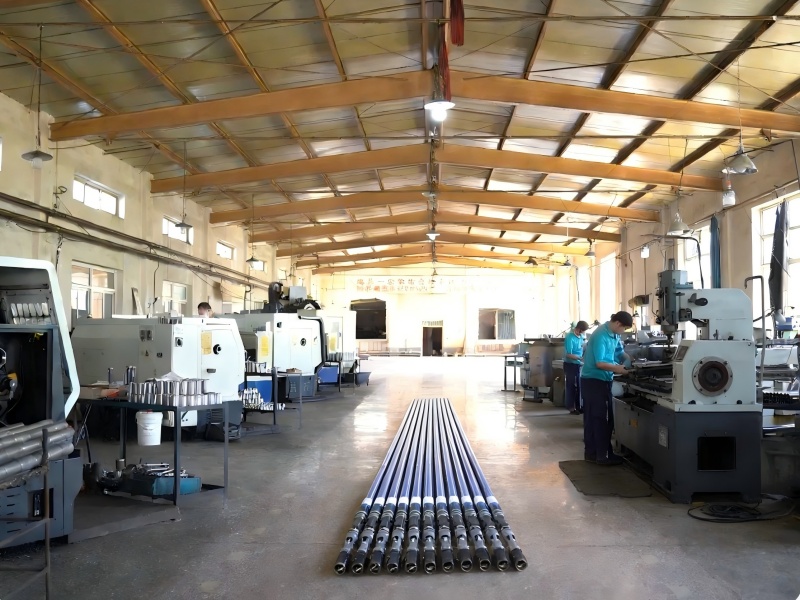
Procurement decisions should go beyond API certification alone. At Dongsheng Petroleum Machinery, every pump undergoes strict quality controls:
Barrel Straightness: ≤ 0.02 mm over full length using vertical honing machines to prevent plunger misalignment and uneven wear.
Surface Roughness: Barrel Ra ≤ 0.2 μm; plunger Ra ≤ 0.1 μm, reducing friction and extending packing life.
Tolerance Fit: 0.0015" – 0.0045" based on fluid viscosity, maximizing volumetric efficiency.
Material Traceability: Heat treatment reports and API 11AX certification (License No. XXXX) ensure metallurgical integrity and consistent performance.
Reference: API Spec 11AX guidelines for subsurface sucker rod pumps.
4. Field Example: Extended Service Life in a Harsh South American Well
Background: Heavy oil well in South America, sand content >15%, measurable H₂S levels.
Initial Setup: Standard chrome-plated plunger pump. Average service interval: ~3–4 months.
Dongsheng Solution: API 11AX-RWAM pump with:
Spray Metal Plunger
Tungsten Carbide Valve Set
Precision-honed barrel
Outcome:
Pump service life extended to ~7–8 months.
Unplanned workover frequency reduced by nearly 50%.
Operational efficiency and total OPEX improved noticeably, with fewer production interruptions.
Note: Field results are indicative; actual outcomes depend on well-specific conditions.
5. Key Takeaways for Procurement Managers
Look beyond initial cost: A lower-priced pump that fails prematurely can cost 3–5 times more in unplanned workovers and lost production.
Verify material and heat treatment: Ensure suppliers provide full traceability and process monitoring to maintain hardness and corrosion resistance.
Ensure system compatibility: Pumps, rods, and couplings must be fully matched to prevent premature rod failures or misalignment issues.
Use failure-mode data for decision-making: Focus on sand content, gas ratio, sour gas exposure, and fluid viscosity when selecting pump configurations.
6. Why Dongsheng Petroleum Machinery?
API 11AX-certified pumps tailored for sand-heavy, corrosive, or high-viscosity wells.
Manufacturing tolerances and metallurgy optimized for long-term reliability.
Field-verified experience reducing downtime and total cost of ownership.