

Introduction: The Backbone of Global Artificial Lift
In the complex landscape of oil and gas extraction, efficiency isn't just a goal—it's a survival mandate. As global reservoirs mature, the reliance on artificial lift systems has never been higher. Among these, the Sucker Rod Pump (SRP), also known as the "beam pump" or "donkey pumper," remains the industry's most reliable workhorse.
For B2B buyers—importers, wholesalers, and OEM partners—selecting a Sucker Rod Pump isn’t merely a purchase; it's a strategic investment in well productivity. This guide delves into the technical intricacies of API standard sucker rod pumps, drawing from decades of engineering expertise at DongSheng Petroleum (DS Rod Pump) to help you navigate selection, operation, and maintenance.
1. Understanding the Sucker Rod Pump Concept
At its core, a Sucker Rod Pump is a reciprocating positive displacement pump. It converts the rotary motion of a surface motor into the vertical reciprocating motion of a downhole plunger via a string of sucker rods.
How it Works: The Four-Phase Cycle
The Downstroke: As the rod string moves downward, the traveling valve on the plunger opens, allowing reservoir fluid already in the pump barrel to pass through.
The Upstroke: The traveling valve closes, and the standing valve at the base of the barrel opens. This creates a vacuum that sucks new fluid into the barrel while simultaneously lifting the column of oil above the plunger toward the surface.
Discharge: The oil is pushed through the production tubing string into the surface flowline.
Repetition: This rhythmic cycle continues, governed by the strokes per minute (SPM) set at the surface pumping unit.
2. Technical Advantages: Why DS Rod Pumps Lead the Market
When sourcing for large-scale projects, technical specifications define the ROI. Our API 11AX Standard pumps are engineered to address the harshest downhole environments.
Precision Engineering & API Compliance
Our products, such as the RHAM (Stationary Heavy Wall Barrel, Top Anchor) and TH (Tubing Pump) series, are manufactured with exacting tolerances. API 11AX certification ensures that every component is interchangeable and meets global safety and performance benchmarks.
Superior Material Science
Corrosion Resistance: We offer barrels and plungers treated with spray-metal (SM), chrome plating, or nickel-carbide coatings to withstand H2S and CO2 environments.
Wear Minimization: By using high-grade carbon steel and alloy steel, our sucker rods and pump barrels minimize the friction-induced wear that typically plagues deep-well operations.
Automated Cleaning Integration (Innovative Tech)
As highlighted in recent patent developments, modern workover operations now benefit from automated tubing and rod cleaning systems. Unlike traditional manual scraping—which is labor-intensive and environmentally hazardous—integrated rotary oil-brushing devices allow for automatic cleaning during the pulling process. This reduces secondary pollution and energy loss, particularly in cold-weather regions like Northern China or Canada.
3. Navigating Scene-Specific Pain Points
Every oil field has a "personality." Recognizing the pain points of your specific environment is the first step in correct selection.
Pain Point A: High Viscosity & Heavy Oil
The Challenge: Thick oil creates massive drag on the rod string, leading to "floating rods" and reduced stroke efficiency.
The DS Solution: Our large-bore tubing pumps (Type TH) provide a wider flow path, reducing fluid friction and allowing for easier passage of viscous crudes.
Pain Point B: Gassy Wells & Gas Interference
The Challenge: Gas pockets can cause "gas lock," where the pump valves fail to open/close because the gas compresses rather than moving the fluid.
The DS Solution: We utilize specialized valve cages and increased compression ratios to ensure gas is efficiently displaced during each stroke.
Pain Point C: Environmental & Cost Pressures
The Challenge: Traditional steam cleaning of rods at the surface creates toxic waste.
The DS Solution: Promoting the use of semi-enclosed thermal fields for cleaning during workovers, which prevents heat loss and contains hazardous waste.
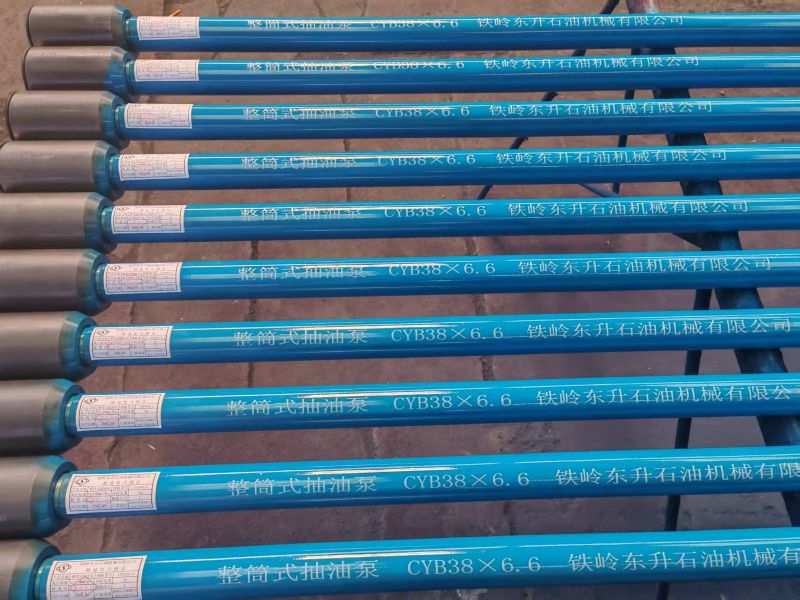
4. B2B Selection Guide: Choosing the Right Pump Type
Choosing between an Insert (Rod) Pump and a Tubing Pump is critical for long-term OpEx.
Tubing Pumps (TH)
Best for: High-volume production.
Design: The barrel is part of the tubing string. To service the pump, the entire tubing string must be pulled.
Advantage: Largest possible bore for a given tubing size, maximizing displacement.
Insert / Rod Pumps (RH / RW)
Best for: Deep wells and high-maintenance wells.
Design: The entire pump is lowered inside the tubing on the sucker rod string.
Advantage: "Pull the rods, pull the pump." Maintenance does not require pulling the tubing, drastically reducing workover costs.
Feature | Tubing Pump (TH) | Insert Pump (RH/RW) |
Production Volume | Highest | Moderate |
Maintenance Cost | Higher (Pull Tubing) | Lower (Pull Rods Only) |
Depth Rating | Moderate | High |
Initial Cost | Lower | Higher |
5. Technical Parameters & Engineering Suggestions
For technical buyers, the "devil is in the details." Here are the parameters you must define before placing an OEM/Wholesale order:
Pump Designation: (e.g., 20-125-RHAM-10-4-2)
20: Tubing size (2.0 inches)
125: Pump bore (1.25 inches)
RHAM: Type (Rod, Heavy Wall, Stationary Barrel, Top Anchor)
10: Total barrel length (ft)
4: Plunger length (ft)
2: Extension length (ft)
Plunger Fit: We recommend a fit of .001" to .005" depending on fluid temperature and viscosity.
Metallurgy: For sandy wells, we suggest a hard-surfaced plunger with a chrome-plated barrel.
6. Common Mistakes in SRP Procurement & Operation
Based on our experience as a leading manufacturer, avoid these four common pitfalls:
Over-sizing the Pump: Many buyers choose the largest bore possible. However, an oversized pump in a low-productivity well leads to "fluid pound," which can shatter rod strings.
Ignoring Rod Stretch: In deep wells (over 5,000 ft), steel rods stretch significantly. If not accounted for in the stroke length, the plunger may never reach the bottom of the barrel.
Neglecting Surface Alignment: Even the best downhole pump will fail if the polished rod is not perfectly aligned with the stuffing box. This causes premature wear and environmental leaks.
Improper Storage: Sucker rods and pump barrels are precision tools. Storing them on the ground without supports leads to "pitting corrosion," which becomes the site of future fatigue cracks.
7. FAQ
Q: How do I know if I need an API 11AX pump versus a non-standard one?
A: Always opt for API 11AX if you operate internationally. It ensures you can source replacement valves, balls, and seats from any global supplier without compatibility issues.
Q: What is the lead time for custom OEM orders?
A: At DS Rod Pump, standard API configurations usually ship within 4-6 weeks, while custom metallurgy for highly corrosive wells may take 8-10 weeks.
Q: Can these pumps handle horizontal wells?
A: Sucker rod pumps can work in deviated wells, but friction increases. We recommend using rod guides and sinker bars to maintain downward momentum.
Q: Is there a way to reduce the environmental footprint of workovers?
A: Yes. Transitioning to automated, closed-loop cleaning systems (as described in our patented tech) eliminates oil spills on the well site.
Conclusion: Partnering for Performance
The Sucker Rod Pump is a testament to the adage that "simplicity is the ultimate sophistication." While the basic mechanics haven't changed in a century, the materials, precision, and integrated technologies have evolved to meet the demands of the modern "Digital Oilfield."
At DS Rod Pump (DongSheng), we don't just sell equipment; we provide recovery solutions. By adhering to strict API standards and innovating in areas like automated cleaning and high-strength alloys, we ensure that your B2B supply chain remains robust and your field operations remain profitable.
Ready to optimize your lift strategy?
Contact our Engineering Team for a detailed technical consultation and bulk pricing.