

Introduction
In any oilfield where natural reservoir pressure has declined below the threshold needed to flow a well, an artificial lift system takes over. The choice of which system to deploy is one of the most consequential production engineering decisions an operator makes — it defines operating costs, maintenance complexity, intervention frequency, and ultimately the economic life of the well.
Two systems are frequently evaluated together for onshore wells with low-to-moderate production rates and challenging fluid characteristics: the sucker rod pump and the progressive cavity pump (PCP). On the surface, they appear to address a similar market — low-to-moderate rate onshore wells, often with heavy or viscous crude, sand production, or depleted reservoir pressure. In practice, they operate on different physical principles, fail in different ways, and are suited to meaningfully different well conditions.
This comparison examines both systems with technical precision — how each works, where each genuinely excels, where each has real limitations, and how the selection decision should be structured for different well scenarios. The goal is not to declare a winner. It is to give the production engineer and equipment evaluator the technical clarity to make the right choice for each specific well.
Understanding the Two Systems: How Each Works
The Sucker Rod Pump: Reciprocating Positive Displacement
A sucker rod pump is a reciprocating positive displacement pump. Its operating principle converts the up-and-down motion of a surface beam pumping unit into a fluid lift action at the downhole pump assembly, transmitted through a string of connected steel rods that can extend more than a mile in length.
The surface pumping unit — the familiar nodding beam structure of the pumpjack — uses an electric motor or engine to drive a walking beam through a gear reducer and crank assembly. The reciprocating motion of the beam travels down the rod string to the plunger inside the pump barrel.
On the upstroke, the rising plunger creates a low-pressure region below it. The standing valve at the base of the pump opens under the pressure differential, allowing produced fluid from the wellbore annulus to fill the expanding barrel cavity. The traveling valve on the plunger remains closed, held shut by the weight of the fluid column above.
On the downstroke, the descending plunger compresses the fluid in the barrel. The standing valve closes, preventing backflow into the annulus. Barrel pressure rises until it exceeds the fluid column pressure above, at which point the traveling valve opens and fluid is displaced upward through the production tubing. One stroke advances one plunger-volume-equivalent of fluid toward the surface.
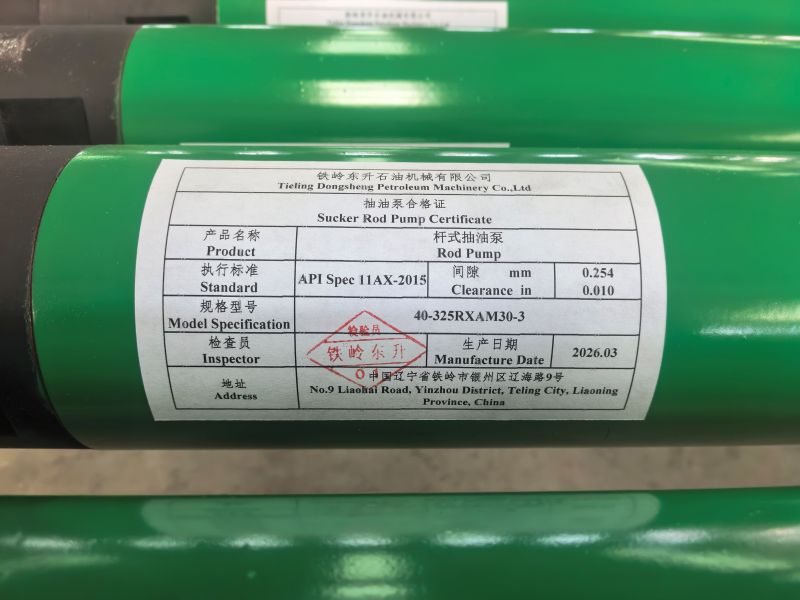
The pump components — barrel, plunger, traveling valve, standing valve — are manufactured to API 11AX dimensional and material specifications. This standardization ensures interchangeability across suppliers, defined performance characteristics, and the minimum quality baseline for professional oilfield deployment. Specialty pump designs have extended the operating envelope beyond the standard API configuration to address gas interference, sand production, high-temperature thermal recovery, and deep-well pressure differentials.
The Progressive Cavity Pump: Rotary Positive Displacement
The progressive cavity pump — also known as a PC pump, Moineau pump, or eccentric screw pump — operates on a fundamentally different physical principle. Where the sucker rod pump uses reciprocating linear motion to displace fluid, the PCP uses slow-speed rotation to move fluid through a sequence of sealed cavities.
The PCP was invented by René Moineau in 1930, originally as a compressor concept for jet engines. Its application to oilfield fluid lifting came later, and it has since become the preferred lift method for specific well conditions where its rotary, low-shear operating principle provides advantages that reciprocating pumps cannot match.
The downhole PCP assembly consists of two primary components: a single-helix hardened steel rotor and a double-helix elastomer stator housed inside a metal tube. The rotor has a slightly smaller diameter than the stator cavity and is offset from the stator centerline. As the rotor turns inside the stator at typically 50 to 500 RPM, its geometry creates a series of sealed cavities at the points of contact between rotor and stator. These cavities move axially through the pump as the rotor turns, carrying fluid from intake to discharge without shearing it.
The geometry is the defining feature of the PCP: because the cavities maintain a fixed size and shape as they travel through the pump, fluid is displaced at a constant rate proportional to rotation speed. Doubling the RPM doubles the theoretical flow rate. The absence of check valves, plunger impacts, and compression-expansion cycles means fluid passes through the pump in a smooth, uninterrupted flow — a characteristic of particular importance when handling shear-sensitive fluids like heavy crude, emulsions, or fluids carrying fragile solids.
Rotation is transmitted from a surface drive head — either an electric motor with variable frequency drive or a hydraulic drive system — down through the rod string to the rotor. Unlike the sucker rod pump's rod string, which is under alternating tension and compression, the PCP rod string transmits torsion — it is a rotating drive shaft rather than a reciprocating tension member. This difference in rod string loading has important consequences for both well conditions and failure modes.
Side-by-Side Technical Comparison
| Parameter | Sucker Rod Pump | Progressive Cavity Pump |
|---|---|---|
| Operating mechanism | Reciprocating piston | Rotary helical rotor/stator |
| Depth range (practical) | Surface to ~14,000 ft (4,270 m) | Best at 1,500–6,000 ft (460–1,830 m) |
| Flow rate range | 10–3,000+ BFPD | 5–1,500 BFPD (optimal 50–500 BPD) |
| Heavy/viscous crude | Good | Excellent — low shear, continuous flow |
| Sand/solids tolerance | Moderate (specialty designs: good) | Excellent — up to 15% solids by volume |
| Gas tolerance (high GOR) | Good (specialty designs: excellent) | Poor — >10–15% free gas causes issues |
| Temperature limit | High — no elastomers downhole | ~120°C (250°F) standard elastomer limit |
| Well deviation | Best in vertical wells | Handles deviated and horizontal |
| Surface footprint | Large (beam unit + counterweights) | Compact drive head |
| Energy efficiency | 40–60% system efficiency | 55–75% system efficiency |
| Fluid shear | Higher (piston action) | Very low (rotary, gentle flow) |
| Intervention type | Rod pull — fast, low cost | Tubing pull — slower |
| Diagnostic capability | Full dynacard diagnostics at surface | Limited downhole visibility |
| Backspin risk | None | High — rod unwinds at power loss |
| API standardization | Full — API 11AX | Limited — stator/rotor not standardized |
| Global installed base | 750,000+ wells | ~50,000–100,000 wells |
The Sucker Rod Pump: Pros and Where It Leads
Proven Performance Across the Broadest Range of Well Conditions
More than 750,000 wells worldwide operate with some form of rod lift — a number that reflects not inertia, but the practical result of matching a reliable technology to the well conditions that describe the majority of the world's onshore oil production. No other single lift method approaches this installed base.
The depth capability of the sucker rod pump extends to approximately 14,000 feet in standard configurations, with specialty deep-well designs using double-layer barrel construction engineered for the 2,600 to 3,500 meter range (approximately 8,500 to 11,500 feet). This depth range covers the productive horizons of the vast majority of onshore oil formations globally. At these depths, the PCP's elastomer stator — which degrades under sustained pressure differential and temperature — becomes increasingly limiting.
Gas Tolerance: A Decisive Advantage Over PCP
Gas-oil ratio management is one of the most common challenges in mature onshore fields. As reservoir pressure declines and solution gas breaks out of crude oil, free gas enters the wellbore and must be managed through the lift system. Here, the sucker rod pump holds a clear and fundamental advantage over the PCP.
In a PCP, free gas entering the rotor-stator cavity cannot be compressed and displaced the way liquid can. Gas that enters the stator compresses on the downhole side without maintaining the pressure differential needed to move fluid — a condition analogous to gas lock in a piston pump, but with added risk: if the pump is running dry on gas with no liquid to lubricate the rotor-stator contact, the elastomer stator overheats rapidly from friction. Stator damage from dry running is the most common catastrophic PCP failure mode, and it occurs fastest in gassy wells where liquid inflow is intermittent.
The sucker rod pump handles gas through both design flexibility and operational management. Pump-off controllers manage intermittent operation to allow barrel refill between strokes. Specialty anti-gas pump designs address sustained high-GOR conditions through a mechanical open-and-close oil inlet valve structure that forces gas exhaust from the barrel on each stroke rather than relying on pressure differential to drive valve action. This design is available in Φ44mm and Φ57mm pump diameter specifications compatible with standard 2 3/8-inch, 2 7/8-inch, and 3 1/2-inch tubing — covering the majority of onshore completion configurations. For wells where gas interference is the primary production challenge, this is not a marginal advantage — it is a decisive one.
Temperature Tolerance: No Elastomers, No Thermal Limits
The PCP's fundamental dependency on an elastomer stator creates a hard temperature ceiling. Standard nitrile and hydrogenated nitrile butadiene rubber (HNBR) stators begin to degrade above approximately 120°C (250°F). High-temperature elastomer formulations extend this to approximately 150–160°C in optimal conditions, but even these limits are exceeded in steam-assisted gravity drainage (SAGD) operations, cyclic steam stimulation wells, and naturally high-temperature deep formations.
The sucker rod pump has no elastomers in the fluid path. Its components — barrel, plunger, valves — are metal throughout. This material characteristic means temperature is not a fundamental constraint on pump operation the way it is for the PCP. The pump continues to function at the temperatures imposed by deep formation heat or active steam injection as long as the metallurgy of the specific components is selected for those conditions.
For thermal recovery applications — one of the most significant production methods for heavy oil — a specialized steam injection pump design incorporates an Inconel 625 alloy bushing in the steam channel. Inconel 625 is a nickel-chromium-molybdenum alloy that withstands continuous steam scouring at 350°C (662°F), a temperature at which no elastomeric stator can survive in service. Field testing at Liaohe Oilfield, one of China's primary heavy oil production regions, confirmed a steam dryness retention rate of 85% or above throughout the steam injection cycle using this design — meaning the pump does not compromise the thermal efficiency of the recovery process.
API 11AX Standardization: Quality You Can Specify, Verify, and Source
The API 11AX standard defines dimensional tolerances, material hardness requirements, valve geometry specifications, and plunger-to-barrel clearance ranges for sucker rod pump components. This standardization accomplishes three things of practical importance for equipment procurement:
Interchangeability: Components from different API 11AX certified manufacturers meet defined dimensional specifications. A pump barrel from one manufacturer accepts a plunger from another — a critical characteristic for field maintenance and supply chain flexibility in remote locations.
Quality floor: Any component certified to API 11AX has been manufactured within validated specifications and passed associated quality audits. ISO 9001 quality management certification at the manufacturing level provides additional assurance about process consistency.
Verifiability: The specifications in API 11AX are publicly documented and independently auditable. Buyers can specify exactly what they require, verify that delivered components meet those requirements, and hold suppliers accountable to the standard.
The PCP has no equivalent comprehensive API standard. Rotor-stator geometry, elastomer compound selection, and dimensional fit are proprietary to each manufacturer. This means that stators from different suppliers are generally not interchangeable, that quality benchmarking across suppliers requires independent testing, and that replacing a failed stator in the field typically means sourcing from the original manufacturer.
Diagnostic Transparency: Seeing Downhole from the Surface
One of the most underappreciated advantages of the sucker rod pump is its diagnostic accessibility. Surface and downhole dynamometer cards — plots of polished rod load versus position throughout the stroke — are generated with standard field equipment and interpreted against well-established mathematical models that have been refined over decades of field application.
A dynamometer card tells the production engineer what is happening at the downhole pump: whether the barrel is filling completely, whether gas interference is occurring, whether the plunger is worn, whether the standing or traveling valve is leaking. Problems are identifiable at the surface before they become failures. This enables proactive intervention scheduling based on measured pump condition rather than fixed time intervals.
The PCP provides no equivalent real-time downhole diagnostic. Surface torque and amperage monitoring can indicate general pump loading, but the specific failure mode — stator wear, rotor-stator interference, rod string torsional stress — is difficult to distinguish remotely. Failures tend to be identified when production declines, at which point the damage is already done.
Fast, Low-Cost Interventions When Service Is Needed
When a sucker rod pump requires service, it is retrieved by pulling the rod string. The production tubing stays in the well. This operation requires a rod-pulling unit — a truck-mounted winch — rather than a full workover rig, and it can typically be completed in 12 to 24 hours. The cost per intervention is a fraction of operations that require rig mobilization.
This intervention economics advantage compounds across a well's production life. In a field with fifty wells requiring annual pump service, the difference between rod-pull and full workover costs multiplied across five years represents a very large number. It is also a risk mitigation factor: a fast, inexpensive intervention means problems can be addressed promptly rather than deferred because of workover scheduling or cost concerns.
Specialty Designs for Wells That Standard Pumps Cannot Reliably Serve
The sucker rod pump's engineering platform has produced specialty designs that address specific difficult well conditions at a level the standard PCP cannot match.
The long plunger sand control pump uses a lateral oil inlet geometry that prevents sand accumulation at the pump intake — the location where packing and bridging most commonly occur in standard designs. The extended plunger-to-barrel contact length distributes abrasive wear over a larger surface area, reducing the rate of clearance growth and extending service interval in formations where a standard pump would require replacement within weeks.
The RXB thick-wall insert pump addresses the dimensional stability challenge of medium-deep to deep well operation. Its thick-wall barrel design, manufactured from high-strength alloy steel with multi-layer wear-resistant coating on the internal bore, maintains bore geometry under the sustained high-differential pressures that cause standard single-wall barrels to deform. The fixed bottom structure eliminates the "breathing effect" — cyclic barrel wall flexion under alternating pressure — improving operating stability by more than 30% compared with conventional designs. Service life in equivalent well conditions is one to three times longer than traditional designs.
The Sucker Rod Pump: Cons Honestly Assessed
Surface footprint: The beam pumping unit — walking beam, gearbox, counterweights, Samson post — requires a significant surface area and is visually prominent. In environmentally sensitive locations, urban-adjacent fields, or offshore platforms (where it is effectively impractical), the large surface equipment is a real constraint.
Deviated and horizontal wells: The rod string requires a near-vertical path to operate efficiently. In wells with significant deviation, the rod-to-tubing contact creates friction, accelerates wear, and increases the risk of rod parting at contact points. Specialty centralizers and friction-reduction components reduce this problem in moderately deviated wells but do not eliminate it. In strongly deviated or horizontal completions, alternative lift methods are generally more practical.
Fluid shear: The reciprocating piston action of the downhole pump imposes more shear on the produced fluid than the PCP's gentle rotary action. For highly viscous crude or fluids where emulsion stability is critical, this shear can increase the viscosity of the produced fluid and complicate surface processing. This is a real but manageable consideration in most heavy oil applications.
Rod string fatigue in high-cycle applications: High stroke rates in heavy fluid applications impose cyclic fatigue on rod connections. Rod parting is the most common catastrophic sucker rod pump failure mode, and it requires a fishing operation to recover the parted rod below the break before the pump can be rerun. Rod string design — grade selection, taper design, coupling inspection intervals — directly affects parting frequency.
The Progressive Cavity Pump: Pros and Where It Leads
Exceptional Heavy Oil and Viscous Fluid Performance
The PCP's single greatest advantage is its handling of highly viscous crude oil and complex non-Newtonian fluids. The rotary cavity mechanism moves fluid continuously without the valve opening-and-closing events, plunger impacts, and compression-expansion cycles of reciprocating pump action. This gentle, continuous displacement subjects viscous fluid to minimal shear — it enters the pump at the intake and exits at the discharge without being worked, chopped, or compressed.
In heavy oil wells producing crude with viscosities in the thousands of centipoise range, PCPs consistently outperform reciprocating pumps in both volumetric efficiency and mechanical wear rate. The pump geometry accommodates the flow characteristics of high-viscosity fluid without requiring the fluid to be pushed through narrow valve passages under high differential pressure.
For wells producing oil-water emulsions with shear-sensitive stability properties, the PCP's low-shear characteristic is valuable not just for pump performance but for surface processing: fluid delivered to the separator with less shear-induced emulsion stabilization requires less chemical treatment and less separation capacity.
Sand and Solids Tolerance
In formations with significant sand cut, the PCP's metal rotor rotating slowly against the elastomer stator at 50 to 500 RPM tolerates abrasive solids in the produced fluid stream far better than high-speed rotating equipment. Properly selected elastomer compounds can handle sand concentrations up to approximately 15% by volume — a level that would destroy ESP impellers in short order and causes measurable wear on sucker rod pump plungers and barrels in standard configurations.
The PCP's tolerance for sand is real and well-documented in fields like the Canadian oil sands and certain Middle Eastern heavy oil formations. However, it is not unlimited. Coarse, angular sand particles at high concentration erode the chrome plating on the rotor over time, gradually opening the rotor-stator clearance and reducing volumetric efficiency. Eventually the rotor profile changes enough that the sealed cavities can no longer maintain the pressure differential needed to lift the fluid column, and pump output declines. The stator elastomer also experiences abrasive wear at the rotor-stator contact line, particularly at higher rotation speeds.
Energy Efficiency Advantage at Low-to-Moderate Rates
System efficiency for PCP installations — the ratio of hydraulic power delivered to the fluid to total input power at the motor — typically ranges from 55% to 75%. This compares favorably to the 40% to 60% range typical of sucker rod pump systems in equivalent applications. The rotary mechanism avoids the energy losses associated with counterweight cycling, rod string acceleration and deceleration, and valve pressure losses in the reciprocating system.
For large fields with many producing wells operating continuously, this efficiency difference translates into meaningful reductions in power consumption and operating cost — particularly in regions where electricity is expensive or where power supply is constrained.
Compact Surface Equipment
The PCP's surface drive head — a motor, gearbox, and drive coupling mounted directly on the wellhead — is significantly more compact than a beam pump unit. In multi-well pad drilling configurations, urban-adjacent fields, and locations where surface space is constrained or visual impact is regulated, the PCP's compact footprint is a genuine operational advantage.
The Progressive Cavity Pump: Cons That Determine Selection
The Elastomer Temperature Ceiling
The single most consequential limitation of the PCP is its dependency on the elastomer stator. Standard nitrile stators degrade above approximately 80–100°C. High-performance HNBR and specialty compound stators extend this limit to approximately 120–150°C in optimal conditions. Above these temperatures, the elastomer swells, loses its mechanical properties, and can bond to the rotor — creating a seized pump that requires rig intervention to recover.
This temperature constraint eliminates the PCP from consideration in thermal recovery applications (steam drive, SAGD), high-temperature deep formations, and any well where wellbore temperature exceeds the stator's operational limit. It also means that downhole temperature must be accurately characterized before PCP deployment — installing a PCP in a well with formation temperature near the elastomer limit, without adequate margin, creates a predictable failure scenario.
Poor Gas Tolerance: A Fundamental Limitation
Gas tolerance is the sharpest functional boundary between the two systems. Where the sucker rod pump can be equipped with specialty designs to handle high gas-oil ratios, the PCP has no equivalent engineering solution to the gas problem.
When free gas enters the PCP at concentrations above approximately 10–15% by volume, several things happen: the sealed cavities in the rotor-stator assembly are partially occupied by compressible gas rather than incompressible liquid. The pump's positive displacement characteristic depends on maintaining liquid-filled cavities; gas-filled cavities compress and re-expand without advancing fluid. Pump output drops sharply.
More critically, if gas concentration is high enough that liquid inflow to the pump becomes intermittent, the rotor-stator contact runs without liquid lubrication. Dry running generates heat at the rotor-stator interface at a rate that the remaining fluid cannot dissipate. Elastomer temperature spikes rapidly and the stator can suffer irreversible damage within minutes of dry operation. A gas pocket in a PCP well is not just an efficiency problem — it can be a catastrophic equipment failure event.
For wells producing above the bubble point with high dissolved gas-oil ratios, or wells with free gas production from naturally fractured intervals, the PCP is not a reliable lift choice without gas separation equipment upstream of the pump intake — adding complexity and cost that partially offsets the system's other advantages.
Backspin: A Safety and Equipment Risk at Power Loss
The PCP's rod string stores torsional energy as the pump operates — the rod string is essentially a long, wound spring under operating conditions. When power fails suddenly, the energy stored in the wound rod string begins to release. The fluid column above the pump, driven by gravity, acts as an accelerant rather than a brake.
As the wound rod string unwinds and the fluid column drives the rotor in reverse, rod string rotation speed can exceed 5,000 RPM — far beyond the design limits of the surface drive head components. Without anti-backspin braking systems, this energy release can destroy the surface drive motor, shear coupling components, and eject hardware from the drive head with significant force.
Anti-backspin systems — mechanical brakes, hydraulic dampeners, or VFD-based dynamic braking — are standard safety equipment on PCP installations, but they add capital cost and require maintenance. In remote field operations where safety monitoring is less rigorous, backspin remains a documented cause of equipment damage and personnel injury.
Rod String Torsional Loading and Deviated Well Complications
While the PCP's rod string is often cited as an advantage in deviated wells relative to the reciprocating rod string of the sucker rod pump, the torsional loading of the PCP drive string creates its own set of complications.
In deviated wells, the torsionally loaded rod string rests against the tubing wall over extended contact intervals. The combination of torque transmission and contact pressure generates sustained wear on both the rod couplings and the tubing interior — a wear pattern that is different from sucker rod pump rod-to-tubing contact, but similarly consequential over time. Rod guides or centralizers reduce this wear but add cost and installation complexity.
The torsional stress itself is a fatigue source. At the coupling connections between rod segments, the combination of tension (from the rod string weight) and torsion (from the torque transmission) creates complex stress states that are more difficult to analyze than the purely tensile-compressive loading of the sucker rod pump string. In wells with significant rotor-stator friction — due to sand ingestion, improper clearance selection, or temperature-related stator swelling — required torque increases, and rod string stress rises accordingly.
Stator Replacement: Full Tubing Pull Required
When the PCP stator wears beyond its effective service range — either from abrasion, thermal degradation, chemical attack, or accumulated rotor-stator clearance growth — it must be replaced. The stator is part of the tubing string. Replacing it requires pulling the entire production tubing from the well — a full workover rig operation.
This is fundamentally different from the sucker rod pump service model, where the downhole pump is retrieved with the rod string, leaving the tubing in place. For wells where stator wear is a recurring issue — high-sand formations, high-temperature applications near the elastomer limit — the cost of each stator replacement workover is significantly higher than the equivalent rod pump service operation.
Scenario-Based Selection Guide
Heavy Oil at Moderate Depth (Below 6,000 ft, Low GOR, Stable Temperature)
This is the PCP's home territory. For wells producing viscous crude at shallow-to-moderate depth, with stable wellbore temperature below the elastomer limit, minimal free gas, and manageable sand concentration, the PCP's low-shear handling, energy efficiency, and sand tolerance combine to produce a compelling case. The compact surface equipment is an additional advantage where space is constrained.
If the same well has a GOR that is trending upward as reservoir pressure declines, or if wellbore temperature is within 20°C of the stator limit, the margin for continued PCP reliability narrows. Plan for the transition point.
High GOR Formation (Free Gas Present, Any Depth)
This is the sucker rod pump's domain. The anti-gas specialty design, pump-off controller management, and the fundamental ability of the reciprocating pump to handle mixed-phase fluid inflow without catastrophic stator damage make the rod pump system the appropriate choice. A PCP in a well with sustained high GOR is operating outside its reliable design envelope.
Deep Wells (Below 6,000 ft / 1,830 m)
As depth increases beyond the PCP's practical operating range — approximately 6,000 feet for standard configurations — elastomer stator performance under sustained high differential pressure becomes problematic. Stator compression set increases, rotor-stator clearance changes, and pump efficiency declines. The sucker rod pump, with its metal components and proven deep-well designs (double-layer barrel, RXB thick-wall insert rated to 10,000 feet), maintains reliable performance at depths the PCP cannot match.
Sandy Formations (Significant Sand Cut, Moderate Depth, Low GOR)
Both systems can handle sand, but with different mechanisms and trade-offs. The PCP handles high sand concentrations (up to 15% by volume) in shallow-to-moderate depth wells more naturally than a standard sucker rod pump. However, the long plunger sand control sucker rod pump design — with its lateral oil inlet geometry and extended plunger contact length — provides a competitive alternative, particularly at depths where the PCP is less reliable or where the gas content makes PCP deployment risky. The right answer depends on the combination of sand cut, GOR, and depth specific to the well.
Thermal Recovery and Steam-Drive Wells
This is exclusively sucker rod pump territory. No PCP design can survive sustained downhole temperatures above 150°C. The thermal recovery specialty sucker rod pump, with its Inconel 625 steam channel bushing and mechanical linkage design, is the purpose-built solution for steam-drive wells. The PCP is not a candidate.
Deviated Wells with Low-GOR Viscous Oil
The PCP has an advantage in deviated wells with low-GOR viscous production at moderate depth. The rotary rod string is less constrained by deviation geometry than the reciprocating rod string, and the pump's efficiency advantage in viscous fluid handling applies throughout the deviation. Anti-backspin protection is mandatory. Temperature characterization along the deviated wellbore path is important — temperature varies with depth in a deviated completion, and the elastomer limit must not be approached at any point in the wellbore.
Common Mistakes in System Selection
Selecting PCP based on heavy oil alone. Heavy oil does not automatically mean PCP is the right choice. The GOR, temperature, depth, and gas content of the produced fluid matter equally. A PCP in a heavy oil well with elevated GOR or temperature near the stator limit will fail predictably and expensively.
Ignoring the temperature characterization requirement for PCP. Wellbore temperature must be measured and compared to the stator's rated limit with adequate margin — at minimum 20°C below the stator limit. Installing a PCP without verified temperature data is a gamble on equipment that costs a full workover to replace when it fails.
Assuming the PCP handles all sand well. The PCP tolerates sand better than most lift systems, but coarse, angular sand at sustained high concentrations erodes the rotor chrome plating and degrades the stator elastomer. Sand characterization — particle size, angularity, and concentration — should inform both the selection decision and the stator compound specification.
Using a standard sucker rod pump configuration in a high-GOR well. A standard API insert pump in a high-GOR formation will experience gas interference ranging from efficiency loss to complete gas lock. The specialty anti-gas design exists precisely for this condition — selecting a standard pump because it is available and familiar is a design error.
Overlooking intervention cost in the total cost comparison. PCP stator replacement requires a full tubing pull. In a well where stator wear occurs every 18 to 24 months, the workover cost accumulates rapidly. Rod pump service by rod pull is significantly less expensive per event. This difference must be included in the total cost of ownership calculation, not just the initial equipment cost.
Frequently Asked Questions
Q: Can a sucker rod pump handle the same heavy oil applications as a PCP?
A: Yes, with appropriate design selection. The sucker rod pump is effective for heavy oil wells across a wider depth and temperature range than the PCP. For highly viscous crude where low-shear fluid handling is critical, the PCP's rotary mechanism has a genuine advantage at moderate depths. For heavy oil in deep wells, high-temperature formations, or wells with elevated GOR — conditions that limit PCP reliability — the rod pump is the appropriate choice. The two systems overlap in their heavy oil application range, and the specific well conditions determine which is more suitable.
Q: What is the typical operating life of a PCP stator before it needs replacement?
A: In wells with moderate temperature, manageable sand content, and low GOR, PCP stators in standard service run 1 to 3 years before wear-related efficiency decline requires replacement. In challenging wells — high sand concentration, temperatures above 100°C, or intermittent gas inflow — service life can fall to 6 to 12 months. Because stator replacement requires a full tubing pull, the frequency of this event directly determines the PCP's total cost of ownership in any given application.
Q: Does the sucker rod pump require more maintenance than a PCP?
A: The two systems have different maintenance profiles rather than different maintenance levels. The sucker rod pump requires regular surface unit lubrication, stuffing box packing maintenance, rod string inspection, and periodic dynamometer testing — most of which can be performed with standard field crew and light equipment. Downhole pump service requires a rod pull. The PCP's surface drive head has fewer moving parts and requires less routine surface maintenance, but downhole stator replacement requires full workover rig mobilization. Over a ten-year production horizon, the total maintenance cost depends heavily on the frequency and cost of downhole interventions — and the rod pull versus tubing pull difference is a significant factor in that calculation.
Q: Is the PCP suitable for deep wells above 6,000 feet?
A: Standard PCP configurations perform best between 1,500 and 6,000 feet. Above 6,000 feet, the sustained high differential pressure across the rotor-stator interface begins to cause elastomer compression set — the stator loses its pre-set geometry and the rotor-stator clearance changes, reducing volumetric efficiency and increasing slip. High-pressure-rated PCP designs exist but are less widely available and more expensive. For consistently deep applications, the sucker rod pump — particularly specialty designs like the RXB thick-wall insert rated to 10,000 feet — is the more reliable choice.
Q: How do I decide between a sucker rod pump and a PCP for a new well?
A: The decision framework should consider five parameters in sequence: (1) Depth — if below 6,000 feet, rod pump is the primary candidate; (2) Temperature — if wellbore temperature exceeds 120°C, rod pump only; (3) GOR — if significant free gas is present, rod pump with anti-gas design; (4) Fluid viscosity and shear sensitivity — if highly viscous, low-GOR, moderate-depth: PCP is competitive; (5) Total cost of ownership over a five to ten year horizon, including intervention frequency and cost for each system in that specific well's conditions. Apply this sequence to the actual well data, not to the general category of "heavy oil well" or "shallow well."
Conclusion
The sucker rod pump and the progressive cavity pump are both legitimate artificial lift technologies with defined strengths and documented limitations. Understanding the technical basis of those strengths and limitations — not the marketing summary, but the actual operating principles and failure modes — is what makes the difference between a selection that performs for years and one that creates recurring problems.
The PCP is a well-engineered solution for its target application: low-to-moderate depth wells producing viscous, low-GOR fluid at temperatures below the elastomer threshold. In that specific envelope, its low-shear fluid handling, energy efficiency, and sand tolerance are genuine advantages. Outside that envelope — in deep wells, high-temperature formations, gas-bearing reservoirs, or applications requiring rapid low-cost service — the PCP's fundamental constraints become the dominant factor.
The sucker rod pump serves the broader range. Its metal components impose no temperature ceiling, its depth capability exceeds the PCP's practical range, its gas tolerance — enhanced by specialty anti-gas designs — covers the well conditions where the PCP cannot reliably function, and its API 11AX standardization provides quality assurance and supply chain flexibility that proprietary PCP stator designs cannot match. When service is needed, a rod pull is faster and less expensive than any alternative. The dynamometer card provides diagnostic visibility that no other lift system offers at the surface.
For the majority of onshore wells — particularly as fields mature, reservoir pressure declines, and well conditions become more demanding — the sucker rod pump's combination of technical flexibility, diagnostic capability, and low intervention cost makes it the lift system that earns its position as the industry's most widely deployed artificial lift solution.
Choose based on the specific well data. Every parameter matters. The cost of the wrong choice is paid over years.