

A Practical Selection Guide Based on Well Conditions, Production Goals, and Maintenance Requirements
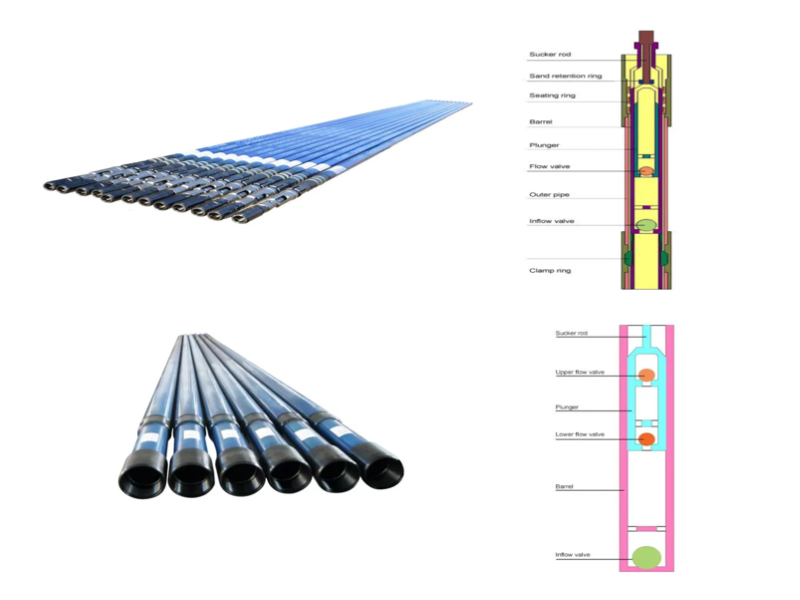
Choosing between an API insert pump and an API tubing pump is one of the most important decisions in a rod pump system. Both pump types are widely used in artificial lift applications and comply with API 11AX standards, but they differ significantly in maintenance procedures, production capacity, workover costs, and suitability for specific well conditions.
In general, insert pumps are often preferred for deep wells, high-sand wells, mature oilfields, and wells requiring frequent maintenance, while tubing pumps are commonly selected for high-production wells where maximum fluid displacement is required. The best choice depends not on the pump itself, but on the actual operating conditions of the well.
What Is an API Tubing Pump?
A tubing pump is installed as part of the tubing string and becomes an integral section of the production tubing.
When the pump needs to be repaired or replaced, the entire tubing string is normally pulled from the well.
Main Characteristics
· Installed directly in the tubing string
· Larger barrel diameter available
· Higher fluid displacement capacity
· Suitable for high-production wells
· Requires tubing retrieval during maintenance
Because of its larger effective pump diameter, the tubing pump is often selected when maximizing production is the primary objective.
What Is an API Insert Pump?
An insert pump is run inside the production tubing and locked into a seating nipple.
Unlike a tubing pump, the tubing string remains in the well during pump servicing.
Only the pump assembly is retrieved.
Main Characteristics
· Installed inside existing tubing
· Easier pump replacement
· Lower workover costs
· Faster maintenance operations
· Suitable for deep wells and wells with frequent interventions
This flexibility makes insert pumps a popular choice in many mature oilfields.
Insert Pump vs Tubing Pump: Key Differences
Comparison Item | Insert Pump | Tubing Pump |
Installation | Inside tubing | Part of tubing string |
Pump Retrieval | Pump only | Entire tubing string |
Workover Cost | Lower | Higher |
Maintenance Time | Shorter | Longer |
Production Capacity | Moderate | Higher |
Deep Well Suitability | Excellent | Good |
High Production Applications | Good | Excellent |
Operational Flexibility | Excellent | Moderate |
Neither pump is universally better.
The correct choice depends on the well's production objectives and operating environment.
Which Pump Should You Choose for Different Well Conditions?
Rather than asking which pump is better overall, operators should ask:
"Which pump is better for my well?"
The answer depends on specific production challenges.
Scenario 1: Deep Wells
Typical Well Conditions
· Well depth exceeds 3,000 meters
· High pulling costs
· Long workover times
· Expensive intervention operations
Main Challenge
Maintenance operations become increasingly expensive as well depth increases.
Pulling the entire tubing string may significantly increase downtime and operating costs.
Recommended Pump
API Insert Pump
Why?
✓ Pump can be retrieved without pulling tubing
✓ Lower workover expenses
✓ Reduced intervention time
✓ Faster return to production
For deep wells, maintenance efficiency is often more valuable than maximum displacement capacity.
Scenario 2: High-Production Wells
Typical Well Conditions
· Strong reservoir energy
· Large fluid production volumes
· Stable operating conditions
· Low maintenance frequency
Main Challenge
Maximizing production rate.
Recommended Pump
API Tubing Pump
Why?
✓ Larger barrel diameters available
✓ Higher displacement capacity
✓ Better fluid lifting capability
✓ Optimized for high-volume production
When production rate is the primary objective, tubing pumps are often the preferred solution.
Scenario 3: High-Sand Wells
Typical Well Conditions
· Continuous sand production
· Accelerated wear of pump components
· Frequent valve failures
· Increased maintenance requirements
Main Challenge
Reducing downtime caused by wear-related failures.
Recommended Pump
API Insert Pump
Why?
✓ Easier pump replacement
✓ Lower repair costs
✓ Reduced workover frequency
✓ Faster maintenance operations
Additional Recommendation
For high-sand environments, operators should also consider:
· Wear-resistant barrels
· Hardened plungers
· Wear-resistant valve assemblies
· Sand control technologies
Maintenance accessibility often becomes more important than maximum production capacity.
Scenario 4: Mature Oil Fields
Typical Well Conditions
· Declining reservoir pressure
· Increasing water cut
· Rising gas production
· Frequent production optimization
Main Challenge
Production conditions change continuously over time.
Recommended Pump
API Insert Pump
Why?
✓ Greater operational flexibility
✓ Easier pump replacement
✓ Lower intervention costs
✓ Better adaptability to changing well conditions
This is one reason insert pumps are widely used in mature oilfields worldwide.
Scenario 5: High-Gas Wells
Typical Well Conditions
· High gas-liquid ratio (GLR)
· Gas interference
· Reduced pump fillage
· Potential gas lock issues
Main Challenge
Maintaining stable pump performance.
Recommended Pump
Either Insert Pump or Tubing Pump
Important Note
The pump type alone usually does not solve gas interference problems.
More important factors include:
· Gas anchors
· Gas separators
· Proper pump setting depth
· Pumping parameter optimization
Recommendation
Select the pump based on production requirements and maintenance strategy rather than gas content alone.
Scenario 6: Remote Oilfields
Typical Well Conditions
· Limited service crews
· Long transportation distances
· High intervention expenses
· Restricted equipment availability
Main Challenge
Reducing maintenance-related downtime.
Recommended Pump
API Insert Pump
Why?
✓ Faster servicing
✓ Lower rig time requirements
✓ Reduced operating costs
✓ Improved maintenance efficiency
For remote operations, maintenance simplicity often becomes a major economic factor.
Scenario 7: Wells Requiring Maximum Production Capacity
Typical Well Conditions
· High fluid production targets
· Strong reservoir support
· Production-focused development strategy
Main Challenge
Achieving maximum liquid output.
Recommended Pump
API Tubing Pump
Why?
✓ Larger effective pump diameter
✓ Higher displacement efficiency
✓ Increased production potential
✓ Better suited for large-volume fluid lifting
In these situations, tubing pumps often provide the highest production capability.
Quick Pump Selection Guide
Well Condition | Recommended Pump |
Deep Well (>3000m) | Insert Pump |
High Production Well | Tubing Pump |
High Sand Well | Insert Pump |
Mature Oil Field | Insert Pump |
Frequent Workovers | Insert Pump |
Remote Oilfield | Insert Pump |
Stable High-Volume Production | Tubing Pump |
Maximum Production Capacity Required | Tubing Pump |
High Gas Well | Depends on operating strategy |
How Maintenance Costs Affect Pump Selection
Pump purchase price is only part of the total operating cost.
Operators should also evaluate:
· Workover frequency
· Pulling costs
· Downtime losses
· Labor requirements
· Production interruption costs
In many wells, lower maintenance expenses can outweigh small differences in pump capacity.
This is one reason insert pumps are frequently selected even when tubing pumps could provide slightly higher production.
FAQ
Is an insert pump always better than a tubing pump?
No. The best choice depends on well conditions, maintenance requirements, and production objectives.
Why are insert pumps commonly used in deep wells?
Because they can be serviced without pulling the entire tubing string, reducing workover costs and downtime.
Do tubing pumps produce more fluid?
In many applications, yes. Tubing pumps typically offer larger barrel diameters and greater displacement capacity.
Which pump is easier to maintain?
Insert pumps are generally easier and faster to service.
Which pump is better for high-sand wells?
Many operators prefer insert pumps because worn components can be replaced more efficiently, reducing downtime and maintenance costs.
Which pump is better for mature oilfields?
Insert pumps are often preferred because they provide greater flexibility as production conditions change over time.
Conclusion
Neither an API insert pump nor an API tubing pump is universally superior. The correct choice depends on well depth, production targets, maintenance requirements, workover costs, and reservoir conditions.
For wells where maintenance efficiency, lower intervention costs, and operational flexibility are critical, insert pumps are often the preferred solution. For wells focused on maximizing fluid production and displacement capacity, tubing pumps often offer the greatest advantage.
Before selecting a pump, operators should evaluate the actual well conditions rather than focusing solely on pump specifications. Matching the pump type to the production environment is often the most effective way to improve long-term performance, reduce operating costs, and maximize oilfield profitability.