

Older oilfields have been facing challenges such as high sand content, high viscosity, and deep formations recently.
Besides initial purchase costs alone, field engineers looking for equipment now consider well workover frequency, operating cycles, and tubing life as their main priority.
Due to their unique mechanical features, API rod pumps have been a topic of great interest in various well operating conditions.
Field Advantage of the Insertion Structure
An API rod pump comprises a sealed support joint and the pump body. Both of these can be lowered into the tubing together with the sucker rod and sealed in place. There is no need to pull the tubing up or down during maintenance; all the tasks such as inspection or replacement can be done simply by lifting the sucker rod.
This is a great help to blocks where the workover time is very limited. Besides that, it greatly shortens the construction time and reduces the damage to the tubing caused by the repeated disassembling, thus practically extending the service life of the tubing string.
Multiple Configurations to Meet the Needs of Thin Oil Wells
Flexibility is almost the only solution that the thin oil wells or areas that are frequently regulated can come up with. From φ28 to φ57, the API rod pumps are manufactured in different diameters for the various production levels. The sealing support joint is compatible with tubing, so that the whole tubing string does not have to be reassembled when the pump diameter is changed.
This feature of the product helps a lot in adjusting the production method while keeping the maintenance costs down.
Selection Considerations for Heavy Oil and Steam Drive Wells
In heavy oils and steam drive areas, high temperature, high viscosity, and sand content in the fluids become the major problems that make pump barrels, plungers, and valves wear out more quickly. Insertion rod pumps mainly perform the function of the pump body that revolve around a fixed device, so pumping equipment made out of this kind of system is ideal for deep and deviated well applications and they also help to reduce the problem of wear.
Used in combination with components such as sand-fixing rings, they tolerate even very severe sand production and the parts that are easily damaged can be replaced so that the supply does not have to be stopped.
Stability Requirements in Gas-Bearing and High-Pour-Efficiency Oil Wells
Gas-bearing or high-pour-efficiency oil wells experience downhole pressure fluctuations rather frequently, and this obviously means that the demand for sealing reliability is going to be higher since that is the only way that the well can remain sealed properly and function normally.
API rod pumps have their overall mechanical stress and sealing design tailored to stable operation. Pump barrel load distribution is also more uniform relative to other pump designs, therefore, API rod pumps are very suitable for long-cycle operations. To the oil wells operators, limiting the number of tubing tripping operations yields more single-well economic benefits than those single equipment investments do.
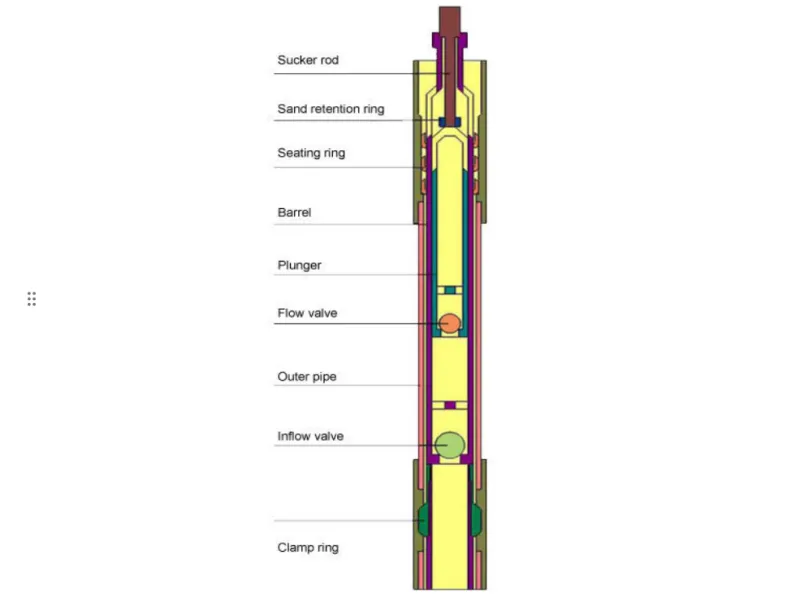
Modular Core Structure Really Makes a Difference in Maintenance Efficiency
The main parts of an API rod pump such as the sucker rod, sand retaining ring, seat ring, barrel, plunger, flow valve, outer tubing, inlet valve, and clamping ring are all laid out in a modular way. The field staff is able to replace the worn-out parts only, without having to replace the whole pump. This can be very helpful in deep and high-viscosity wells where the time and the effort for maintenance can be drastically decreased.
How to Choose the Right One for Different Well Conditions?
Usually, during practical decision-making, engineers will weigh up various factors such as well depth, well inclination angle, the amount of sand, fluid properties, and interval of well workover. When well conditions vary rapidly and the operating regime is frequently adjusted, API rod pumps of a broad specification range should be given the first priority. In heavy oil or steam-driven blocks, sand resistance and operating cycle should be the primary focus. The insert-type structure and the ability to swing the pump body should be taken advantage of to lessen the risk of uneven wear when dealing with deep or deviated wells.
At present, the insert-type API rod pumps that meet the API and GB/T18607-2008 standards are employed in different types of oil wells: light oil ones, heavy oil ones, high-condensate ones as well as steam-driven blocks. Industry discussions seem to focus less and less on the performance of a particular piece of equipment and more and more on operational effectiveness as a whole, maintenance methods, and comprehensive cost control. It is often more feasible for oilfields to resort to a suitable API rod pump selection strategy rather than being stuck on the issue of frequent equipment replacement.
Email:jason@tldspm.com
Phone:+86-13052798822
Whatsapp:+86-15104247781